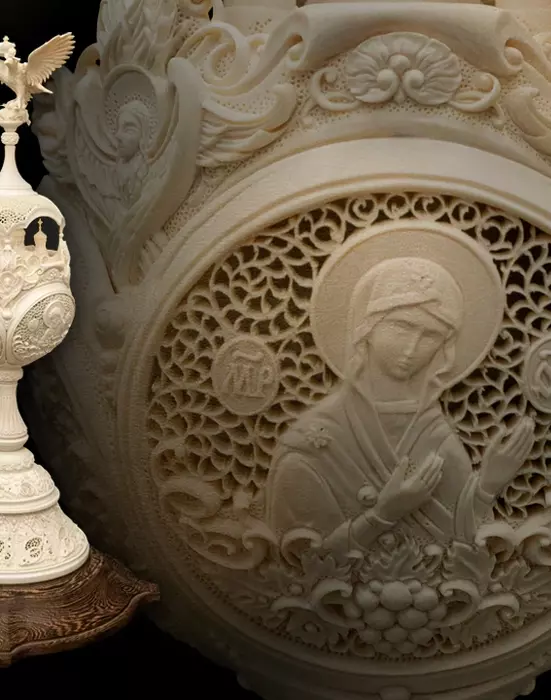
Artistic carving
(339)Expand
Filters
Available first
Artistic carving
Artistic carving: the catalog of exclusive gifts of the store LuxPodarki.ru handmade with delivery in Moscow, Russia and abroad. All products are in stock, guaranteed!
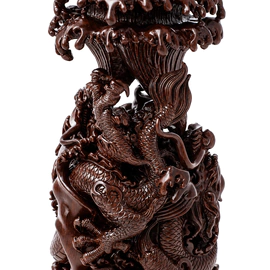
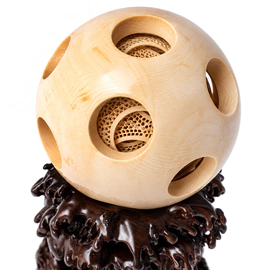
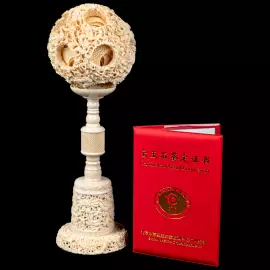
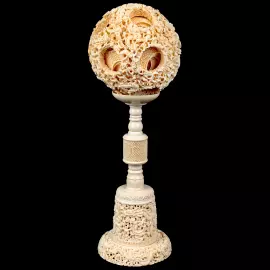
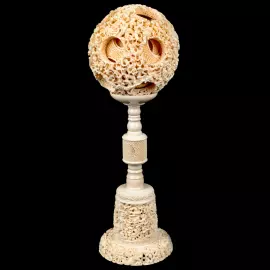
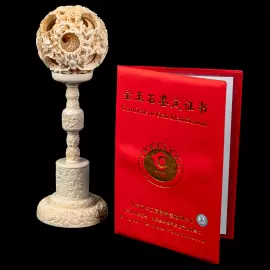
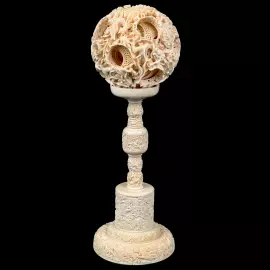
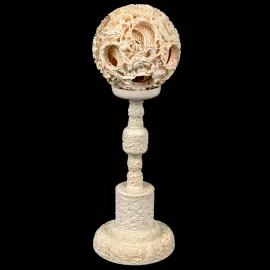
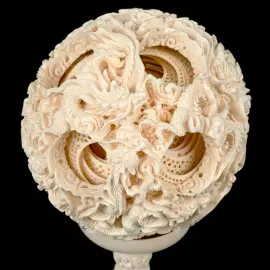
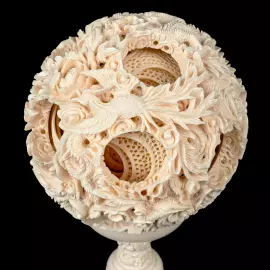
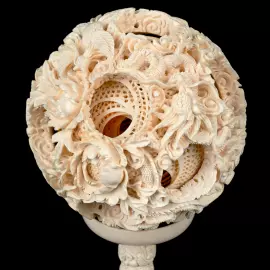
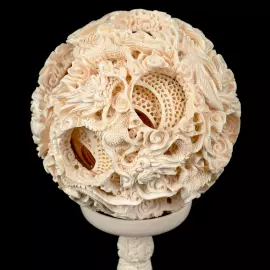
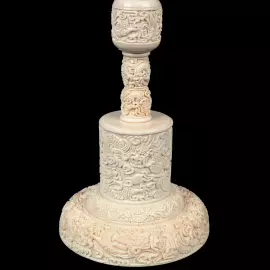
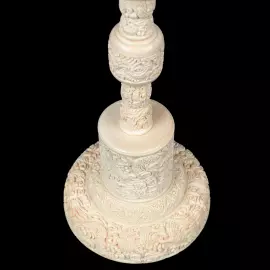
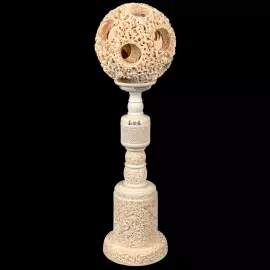
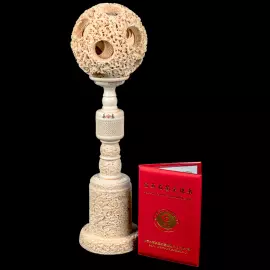
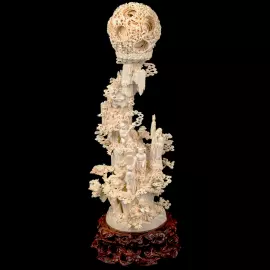
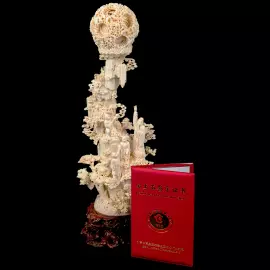
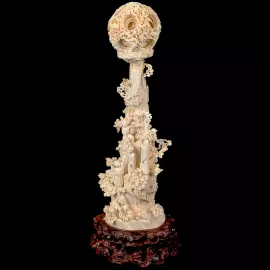
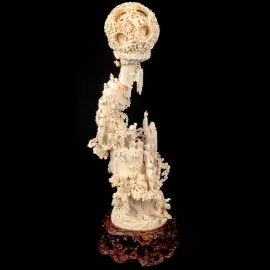
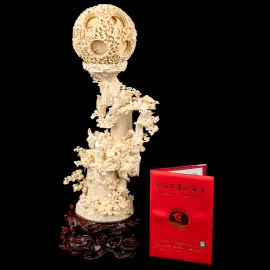
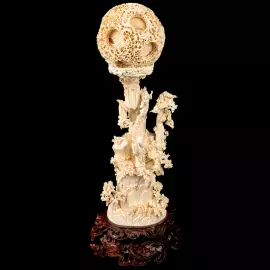
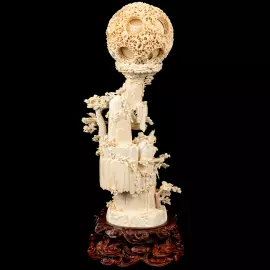
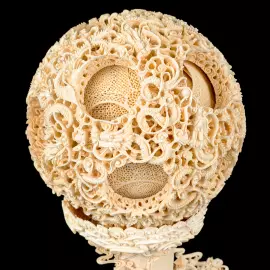
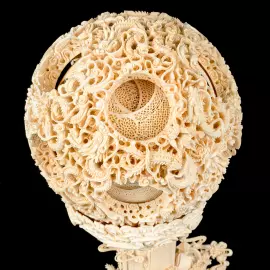
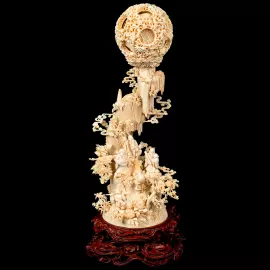
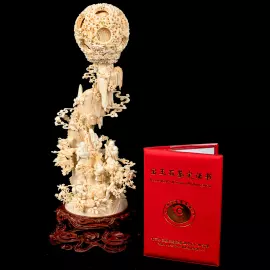
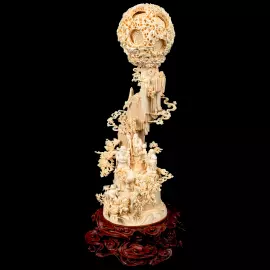
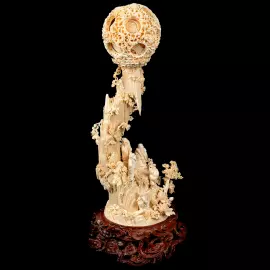
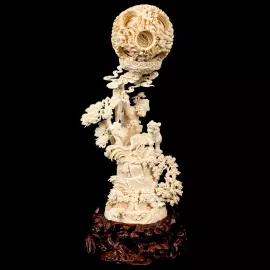
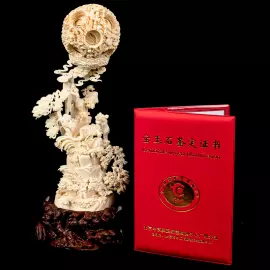
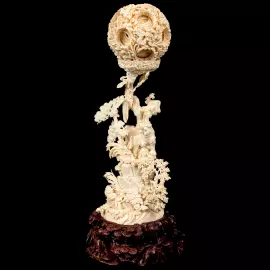
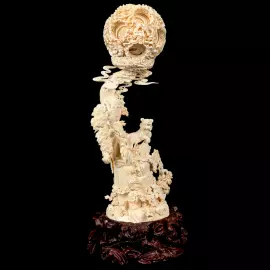
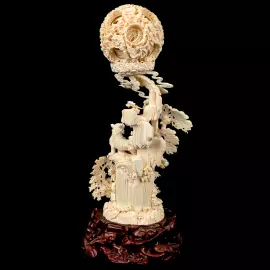
Mammoth tusk composition with Cantonese ball "Dragon" 40 spheres
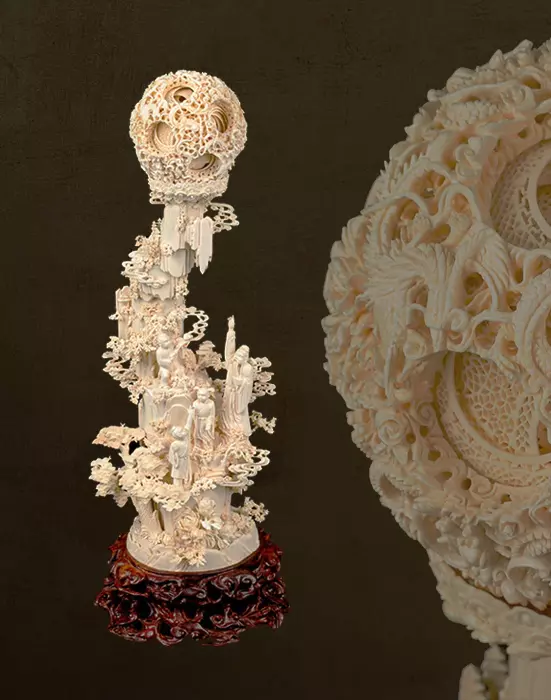
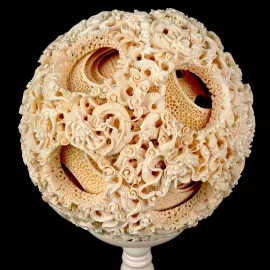
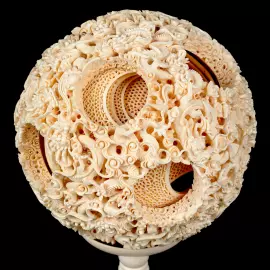
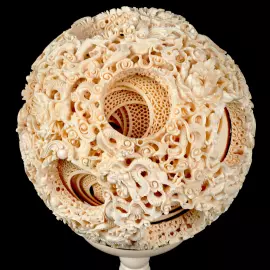
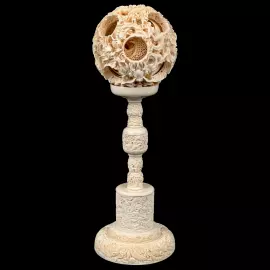
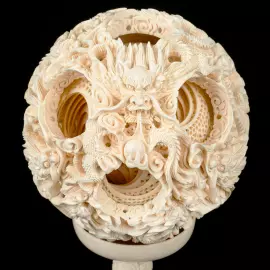
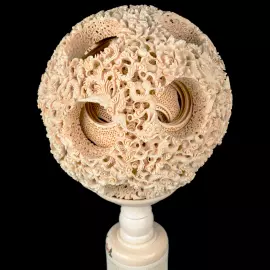
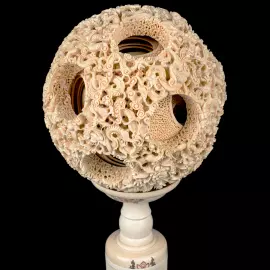
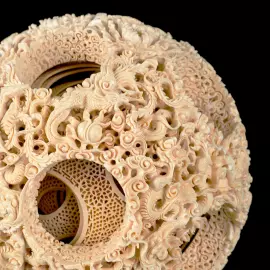
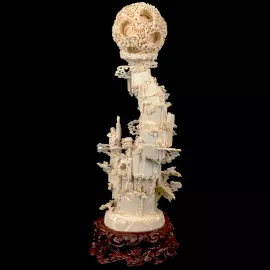
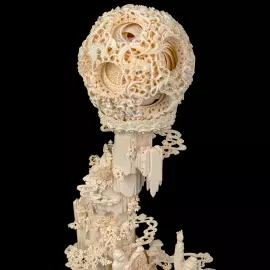
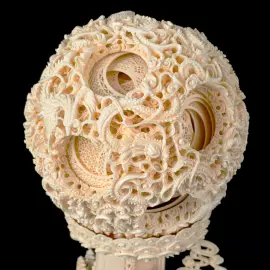
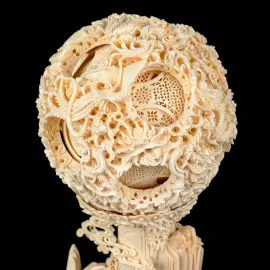
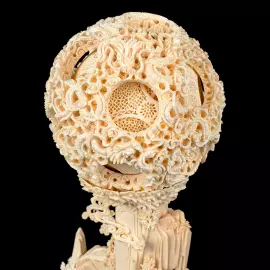
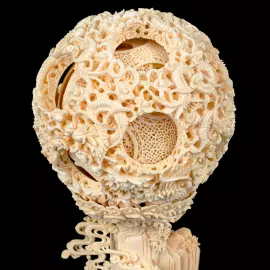
The Cantonese ivory ball, also known as the "ghost ball", is one of the most characteristic types of Guangzhou carvings, formed back in the Ming Dynasty. Its uniqueness lies in the fact that a single fragment of bone is hollowed out into a multi-layered sphere with intertwining openwork shells. Each layer is finely worked out with its own through-the-wall ornament and can freely rotate inside the subsequent one, creating the impression of lightness and almost weightless transparency.
The Cantonese ball is considered the pinnacle of local school craftsmanship and an important part of China's national intangible cultural heritage. Modern works often use a single mammoth tusk, which makes it possible to create complex multi-layered structures with filigree precision. The most important indicator of the master's level is the number of inner spheres: the more layers are enclosed in one ball, the higher the technical complexity and the more virtuoso the work is considered. Creating a large number of freely rotating shells requires exceptional calculation accuracy, error-free tool ownership and many years of experience.
The process of hollowing out a single multilayer sphere is extremely laborious and involves a high risk of material damage at any stage. It is this technical complexity combined with artistic ingenuity that gives the "ghost ball" its unique charm and makes each piece a testament to outstanding craftsmanship.
2 060 000 ₽
Available:
Lubyanka
Mammoth tusk composition with Cantonese ball "Dragon in flowers" 48 spheres
The Cantonese ivory ball, also known as the "ghost ball", is one of the most characteristic types of Guangzhou carvings, formed back in the Ming Dynasty. Its uniqueness lies in the fact that a single fragment of bone is hollowed out into a multi-layered sphere with intertwining openwork shells. Each layer is finely worked out with its own through-the-wall ornament and can freely rotate inside the subsequent one, creating the impression of lightness and almost weightless transparency.
The Cantonese ball is considered the pinnacle of local school craftsmanship and an important part of China's national intangible cultural heritage. Modern works often use a single mammoth tusk, which makes it possible to create complex multi-layered structures with filigree precision. The most important indicator of the master's level is the number of inner spheres: the more layers are enclosed in one ball, the higher the technical complexity and the more virtuoso the work is considered. Creating a large number of freely rotating shells requires exceptional calculation accuracy, error-free tool ownership and many years of experience.
The process of hollowing out a single multilayer sphere is extremely laborious and involves a high risk of material damage at any stage. It is this technical complexity combined with artistic ingenuity that gives the "ghost ball" its unique charm and makes each piece a testament to outstanding craftsmanship.
5 120 000 ₽
Available:
Lubyanka
Mammoth tusk composition with Cantonese ball "Dragon and Phoenix" 28 spheres
The Cantonese ivory ball, also known as the "ghost ball", is one of the most characteristic types of Guangzhou carvings, formed back in the Ming Dynasty. Its uniqueness lies in the fact that a single fragment of bone is hollowed out into a multi-layered sphere with intertwining openwork shells. Each layer is finely worked out with its own through-the-wall ornament and can freely rotate inside the subsequent one, creating the impression of lightness and almost weightless transparency.
The Cantonese ball is considered the pinnacle of local school craftsmanship and an important part of China's national intangible cultural heritage. Modern works often use a single mammoth tusk, which makes it possible to create complex multi-layered structures with filigree precision. The most important indicator of the master's level is the number of inner spheres: the more layers are enclosed in one ball, the higher the technical complexity and the more virtuoso the work is considered. Creating a large number of freely rotating shells requires exceptional calculation accuracy, error-free tool ownership and many years of experience.
The process of hollowing out a single multilayer sphere is extremely laborious and involves a high risk of material damage at any stage. It is this technical complexity combined with artistic ingenuity that gives the "ghost ball" its unique charm and makes each piece a testament to outstanding craftsmanship.
3 010 000 ₽
Available:
Lubyanka
Mammoth tusk composition with Cantonese ball "Dragon and Birds" 45 spheres
The Cantonese ivory ball, also known as the "ghost ball", is one of the most characteristic types of Guangzhou carvings, formed back in the Ming Dynasty. Its uniqueness lies in the fact that a single fragment of bone is hollowed out into a multi-layered sphere with intertwining openwork shells. Each layer is finely worked out with its own through-the-wall ornament and can freely rotate inside the subsequent one, creating the impression of lightness and almost weightless transparency.
The Cantonese ball is considered the pinnacle of local school craftsmanship and an important part of China's national intangible cultural heritage. Modern works often use a single mammoth tusk, which makes it possible to create complex multi-layered structures with filigree precision. The most important indicator of the master's level is the number of inner spheres: the more layers are enclosed in one ball, the higher the technical complexity and the more virtuoso the work is considered. Creating a large number of freely rotating shells requires exceptional calculation accuracy, error-free tool ownership and many years of experience.
The process of hollowing out a single multilayer sphere is extremely laborious and involves a high risk of material damage at any stage. It is this technical complexity combined with artistic ingenuity that gives the "ghost ball" its unique charm and makes each piece a testament to outstanding craftsmanship.
4 760 000 ₽
Available:
Lubyanka
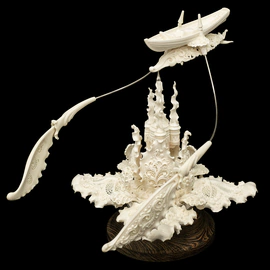
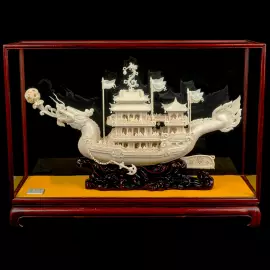
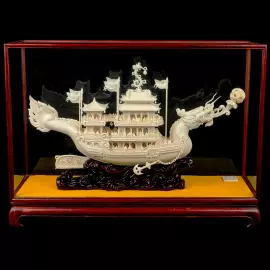
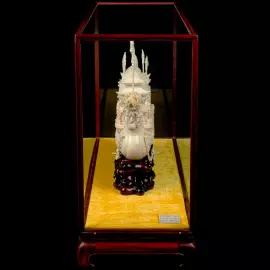
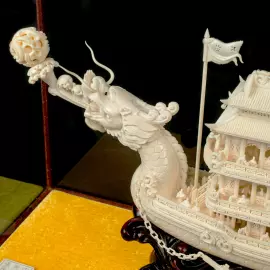
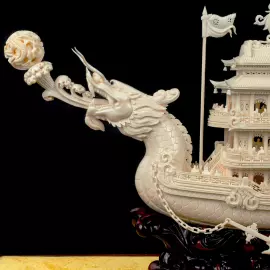
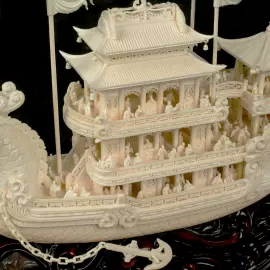
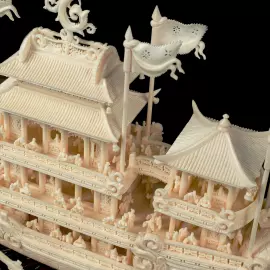
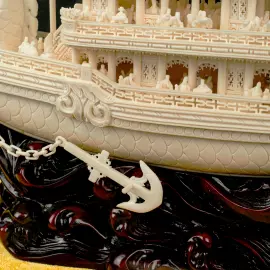
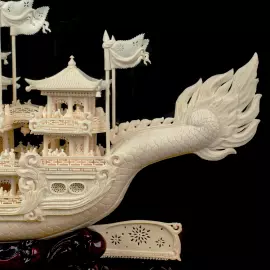
Bone composition "Changle Weiyang draws a dragon boat"
Creative idea: the form of the work is majestic and harmonious. The work uses a wide range of traditional techniques — circular carving, relief, through-the-wall tracery, complex multi-tiered compositions and mosaic elements. All the details are executed with exceptional precision and attention to the smallest nuances.
The pavilions rise and fall sequentially, creating a sense of movement and layering of the space. The scenes of festivities and folk entertainment give the work dynamics and richness. An auspicious dragon with its head held high, full of inner dignity, symbolizes the courage to move forward and portends a successful, safe voyage.
The scale of the idea and the virtuosity of the performance make a strong impression, forcing us to return to contemplation of this work again and again.
8 580 000 ₽

Available:
Lubyanka
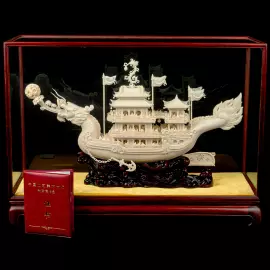
The Huafang Bone Dragon Ship is medium
Creative idea: the form of the work is majestic and harmonious. The work uses a wide range of traditional techniques — circular carving, relief, through-the-wall tracery, complex multi-tiered compositions and mosaic elements. All the details are executed with exceptional precision and attention to the smallest nuances.
The pavilions rise and fall sequentially, creating a sense of movement and layering of the space. The scenes of festivities and folk entertainment give the work dynamics and richness. An auspicious dragon with its head held high, full of inner dignity, symbolizes the courage to move forward and portends a successful, safe voyage.
The scale of the idea and the virtuosity of the performance make a strong impression, forcing us to return to contemplation of this work again and again.
1 990 000 ₽
Available:
Lubyanka
Mammoth tusk composition with Cantonese ball "Appeal to the rising sun" 36 spheres
The Cantonese bone ball, also known as the "ghost ball", is one of the most characteristic types of Guangzhou carvings, formed back in the Ming Dynasty. Its uniqueness lies in the fact that a single fragment of bone is hollowed out into a multi-layered sphere with intertwining openwork shells. Each layer is finely worked out with its own through-the-wall ornament and can freely rotate inside the subsequent one, creating the impression of lightness and almost weightless transparency.
The Cantonese ball is considered the pinnacle of local school craftsmanship and an important part of China's national intangible cultural heritage. Modern works often use a single mammoth tusk, which makes it possible to create complex multi-layered structures with filigree precision. The most important indicator of the master's level is the number of inner spheres: the more layers are enclosed in one ball, the higher the technical complexity and the more virtuoso the work is considered. Creating a large number of freely rotating shells requires exceptional calculation accuracy, error-free tool ownership and many years of experience.
The process of hollowing out a single multilayer sphere is extremely laborious and involves a high risk of material damage at any stage. It is this technical complexity combined with artistic ingenuity that gives the "ghost ball" its unique charm and makes each piece a testament to outstanding craftsmanship.
8 144 000 ₽
Available:
Lubyanka
Mammoth tusk composition with Cantonese ball "I raise a glass and invite the moon" 47 spheres
The Cantonese bone ball, also known as the "ghost ball", is one of the most characteristic types of Guangzhou carvings, formed back in the Ming Dynasty. Its uniqueness lies in the fact that a single fragment of bone is hollowed out into a multi-layered sphere with intertwining openwork shells. Each layer is finely worked out with its own through-the-wall ornament and can freely rotate inside the subsequent one, creating the impression of lightness and almost weightless transparency.
The Cantonese ball is considered the pinnacle of local school craftsmanship and an important part of China's national intangible cultural heritage. Modern works often use a single mammoth tusk, which makes it possible to create complex multi-layered structures with filigree precision. The most important indicator of the master's level is the number of inner spheres: the more layers are enclosed in one ball, the higher the technical complexity and the more virtuoso the work is considered. Creating a large number of freely rotating shells requires exceptional calculation accuracy, error-free tool ownership and many years of experience.
The process of hollowing out a single multilayer sphere is extremely laborious and involves a high risk of material damage at any stage. It is this technical complexity combined with artistic ingenuity that gives the "ghost ball" its unique charm and makes each piece a testament to outstanding craftsmanship.
12 356 000 ₽
Available:
Lubyanka
Mammoth tusk composition with Cantonese ball "Jixing Gaozhao Height" 35 spheres
The Cantonese bone ball, also known as the "ghost ball", is one of the most characteristic types of Guangzhou carvings, formed back in the Ming Dynasty. Its uniqueness lies in the fact that a single fragment of bone is hollowed out into a multi-layered sphere with intertwining openwork shells. Each layer is finely worked out with its own through-the-wall ornament and can freely rotate inside the subsequent one, creating the impression of lightness and almost weightless transparency.
The Cantonese ball is considered the pinnacle of local school craftsmanship and an important part of China's national intangible cultural heritage. Modern works often use a single mammoth tusk, which makes it possible to create complex multi-layered structures with filigree precision. The most important indicator of the master's level is the number of inner spheres: the more layers are enclosed in one ball, the higher the technical complexity and the more virtuoso the work is considered. Creating a large number of freely rotating shells requires exceptional calculation accuracy, error-free tool ownership and many years of experience.
The process of hollowing out a single multilayer sphere is extremely laborious and involves a high risk of material damage at any stage. It is this technical complexity combined with artistic ingenuity that gives the "ghost ball" its unique charm and makes each piece a testament to outstanding craftsmanship.
4 914 000 ₽

Available:
Lubyanka
Mammoth tusk composition "Beautiful China"
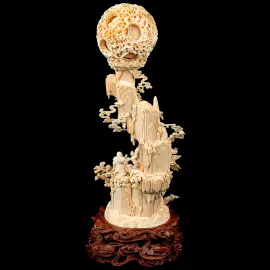
The mammoth tusk composition "Beautiful China", made in the technique of Cantonese carving, is a large-scale work of decorative and applied art, combining architecture, nature and human scenes in a single space. The work was created from a mammoth tusk, the natural arc of which formed the basis of the entire plastic composition. The bend of the material has been transformed into a bridge of time, over which a panorama of ancient China unfolds — with palace pavilions, terraces, bridges and gazebos hidden among dense gardens.
The central place is occupied by a multi—tiered palace with a colonnade and balustrades, inside which miniature figures of people can be distinguished - scenes of court life, conversations, ceremonies. There are trees with carefully designed foliage, flowering shrubs, pines, willows, curved branches over which cranes hover — a symbol of longevity and wisdom. Every detail is hand-carved, from the finest architectural ornaments to tiny human silhouettes. The depth of the carving creates an effect of versatility, so that the composition is perceived as a living scene that goes into perspective.
The base is made of dark wood with delicate carvings, emphasizing the status of the work and creating a contrast with the noble cream shade of the tusk. "Beautiful China" is not just a decorative object, but a museum—level performance, the embodiment of the traditions of the Cantonese school, known for its filigree detailing and complex spatial composition. The item is intended for collectors, connoisseurs of Oriental culture and investors in rare works of art, which combine historical plot, rare material and the highest skill of the carver.
11 000 000 ₽
Available:
Lubyanka
Mammoth tusk composition with Cantonese Dragon ball 36 spheres
The Cantonese ivory ball, also known as the "ghost ball", is one of the most characteristic types of Guangzhou carvings, formed back in the Ming Dynasty. Its uniqueness lies in the fact that a single fragment of bone is hollowed out into a multi-layered sphere with intertwining openwork shells. Each layer is finely worked out with its own through-the-wall ornament and can freely rotate inside the subsequent one, creating the impression of lightness and almost weightless transparency.
The Cantonese ball is considered the pinnacle of local school craftsmanship and an important part of China's national intangible cultural heritage. Modern works often use a single mammoth tusk, which makes it possible to create complex multi-layered structures with filigree precision. The most important indicator of the master's level is the number of inner spheres: the more layers are enclosed in one ball, the higher the technical complexity and the more virtuoso the work is considered. Creating a large number of freely rotating shells requires exceptional calculation accuracy, error-free tool ownership and many years of experience.
The process of hollowing out a single multilayer sphere is extremely laborious and involves a high risk of material damage at any stage. It is this technical complexity combined with artistic ingenuity that gives the "ghost ball" its unique charm and makes each piece a testament to outstanding craftsmanship.
1 670 000 ₽
Available:
Lubyanka
Mammoth tusk composition with Cantonese ball "Dragon" 25 spheres
The Cantonese ivory ball, also known as the "ghost ball", is one of the most characteristic types of Guangzhou carvings, formed back in the Ming Dynasty. Its uniqueness lies in the fact that a single fragment of bone is hollowed out into a multi-layered sphere with intertwining openwork shells. Each layer is finely worked out with its own through-the-wall ornament and can freely rotate inside the subsequent one, creating the impression of lightness and almost weightless transparency.
The Cantonese ball is considered the pinnacle of local school craftsmanship and an important part of China's national intangible cultural heritage. Modern works often use a single mammoth tusk, which makes it possible to create complex multi-layered structures with filigree precision. The most important indicator of the master's level is the number of inner spheres: the more layers are enclosed in one ball, the higher the technical complexity and the more virtuoso the work is considered. Creating a large number of freely rotating shells requires exceptional calculation accuracy, error-free tool ownership and many years of experience.
The process of hollowing out a single multilayer sphere is extremely laborious and involves a high risk of material damage at any stage. It is this technical complexity combined with artistic ingenuity that gives the "ghost ball" its unique charm and makes each piece a testament to outstanding craftsmanship.
1 380 000 ₽
Available:
Lubyanka
Cantonese mammoth tusk ball "Crabs and fishes" on a wooden stand
The Cantonese Crab and Fish ball on a wooden stand is a unique piece of bone—cutting art made from a mammoth tusk and demonstrates the highest level of craftsmanship of the traditional Chinese school. The composition is a multi-layered sphere cut from a single piece of material, inside which are hidden movable concentric elements. The outer layer is decorated with intricate openwork carvings with images of marine life, creating a sense of depth and continuous movement of the shape. A stand made of dark carved wood completes the look, giving the product the status of a finished interior object.
The work is made in the technique of Cantonese carving, known for its exceptional complexity and filigree precision. Each layer of the ball is cut by hand, while the master preserves the integrity of the material, creating movable inner spheres without a single joint. The ornamental grid covering the surface has been worked out to the smallest detail: the finest lines, weaves and through elements form a complex spatial structure. The images of crabs and fish are made in a relief manner, organically intertwining with the overall drawing and emphasizing the artistic expressiveness of the composition.
In Chinese culture, crabs and fish have a deep symbolic meaning associated with prosperity, harmony and sustainable well-being. Fish is traditionally associated with abundance and a continuous stream of good luck, while crab symbolizes success and advancement, especially in the business sphere. In combination with the shape of a multi—layered ball reflecting the idea of infinity and perfection, the composition acquires an additional meaning - as a wish for prosperity, stability and inner balance. This is not just a decorative item, but a rare collector's item that combines cultural heritage, symbols and outstanding craftsmanship.
720 000 ₽
Available:
Lubyanka
Cantonese mammoth tusk ball "Fish in nets" on a carved stand
The Cantonese mammoth tusk ball "Fish in Nets" on a carved stand is an exceptional work of artistic carving, which combines rare natural material and the highest school of Chinese craftsmanship. The composition is a multi-layered sphere carved from a single fragment of a tusk, mounted on an elegant stand decorated with embossed floral and marine motifs. The surface of the ball is covered with a complex openwork network, through which the inner moving layers are visible, creating a feeling of depth and endless space.
The work is done in the tradition of Cantonese carving, which requires jewelry precision and many years of experience. Each inner layer of the ball is hand-cut without separating the material, thereby achieving the effect of freely rotating spheres within a single shape. The ornamental structure resembles intertwined nets, in which a dynamic composition unfolds with images of fish, shells and aquatic plants. The finest elaboration of scales, fins and decorative elements emphasizes the virtuosity of execution and gives the product an expressive plasticity.
The plot of "fish in nets" in Chinese culture is filled with deep symbolic meaning. Fish is traditionally associated with abundance, sustainable well-being and a continuous stream of good luck, and the motif of the net reinforces the idea of accumulating and retaining wealth. This combination of images is perceived as a sign of well-wishing for stability, financial growth and harmony in business. The multi-layered shape of the ball, reflecting the idea of infinity and perfection, makes the composition not only an outstanding interior accent, but also a significant symbolic object, valuable for collectors and connoisseurs of high art.
2 900 000 ₽
Available:
Lubyanka
Mammoth tusk composition "Guanyin in flowers showered from heaven"
The composition of the mammoth tusk "Guanyin in flowers showered from heaven" is a work of Cantonese carving, in which the tradition of oriental plastic art is brought to almost jewelry subtlety. The image of the goddess of mercy Guanyin was created from the tusk, surrounded by flowers, flowing cloud ribbons and an elegant bird directed to her palm. The warm natural shade of the material emphasizes the purity of the lines and the softness of the shapes, and the complex composition, mounted on a carved wooden stand, gives the work completeness and a museum character.
The technique of Cantonese carving involves a multi-layered study of space, deep relief and filigree detailing. Here, the master creates a sense of movement: the folds of the robes fall freely, the flowers open one by one, the clouds seem to float around the figure. The surface is treated with exceptional care — smooth areas contrast with the thinnest slit of petals and ornaments, so that the light gently glides over the carving, revealing volume and depth.
The image of Guanyin surrounded by heavenly flowers symbolizes compassion, protection and blessing. The composition is perceived not just as a decorative object, but as the philosophical center of the interior — a work that can create an atmosphere of peace and inner harmony in the space. This is a rare collector's item created for connoisseurs of oriental art, museum collections and private rooms, where cultural meaning, craftsmanship and genuine artistic complexity are appreciated.
11 700 000 ₽
Available:
Lubyanka
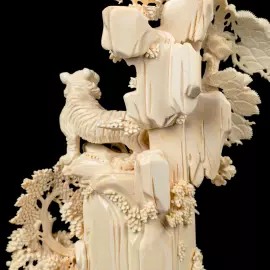
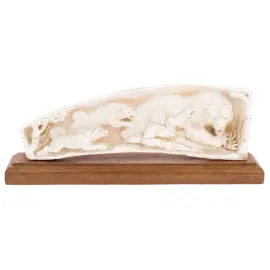
Bone composition with Cantonese ball "Greatness and authority" 28 spheres
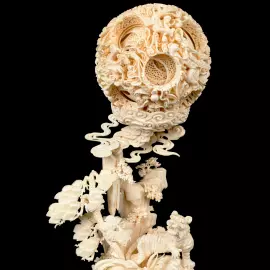
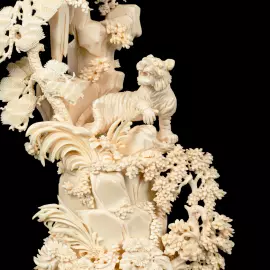
In the center of the mountain forest, on a stone ledge, a ferocious tiger lurks — the visual focus of the whole composition. His head is slightly raised, his gaze is burning like fire, his mustache is tense like steel needles. The muscular body is conveyed with amazing precision: the direction of the coat emphasizes the relief of the muscles, creating a feeling of explosive power hidden under the skin.
Using the "movement through rest" technique, the master captured the moment before the jump. In the motionless form, there is a growing tension — the very state when "the wind is born from the roar of the tiger." Static carving is filled with internal dynamics and strength.
The image of the beast becomes a metaphor for power and natural energy, expressing deep respect for the elements and admiration for the life force of the world.
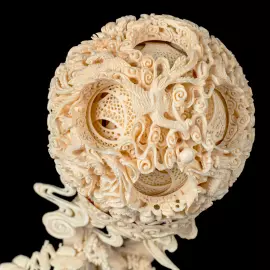
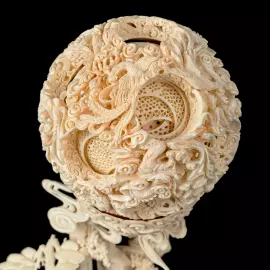
The Cantonese bone ball, also known as the "ghost ball", is one of the most characteristic types of Guangzhou carvings, formed back in the Ming Dynasty. Its uniqueness lies in the fact that a single fragment of bone is hollowed out into a multi-layered sphere with intertwining openwork shells. Each layer is finely worked out with its own through-the-wall ornament and can freely rotate inside the subsequent one, creating the impression of lightness and almost weightless transparency.
The Cantonese ball is considered the pinnacle of local school craftsmanship and an important part of China's national intangible cultural heritage. Modern works often use a single mammoth tusk, which makes it possible to create complex multi-layered structures with filigree precision. The most important indicator of the master's level is the number of inner spheres: the more layers are enclosed in one ball, the higher the technical complexity and the more virtuoso the work is considered. Creating a large number of freely rotating shells requires exceptional calculation accuracy, error-free tool ownership and many years of experience.
The process of hollowing out a single multilayer sphere is extremely laborious and involves a high risk of material damage at any stage. It is this technical complexity combined with artistic ingenuity that gives the "ghost ball" its unique charm and makes each piece a testament to outstanding craftsmanship.
2 380 000 ₽
Available:
Lubyanka
Mammoth tusk composition with Cantonese ball "Sage" 20 spheres
The Cantonese bone ball, also known as the "ghost ball", is one of the most characteristic types of Guangzhou carvings, formed back in the Ming Dynasty. Its uniqueness lies in the fact that a single fragment of bone is hollowed out into a multi-layered sphere with intertwining openwork shells. Each layer is finely worked out with its own through-the-wall ornament and can freely rotate inside the subsequent one, creating the impression of lightness and almost weightless transparency.
The Cantonese ball is considered the pinnacle of local school craftsmanship and an important part of China's national intangible cultural heritage. Modern works often use a single mammoth tusk, which makes it possible to create complex multi-layered structures with filigree precision. The most important indicator of the master's level is the number of inner spheres: the more layers are enclosed in one ball, the higher the technical complexity and the more virtuoso the work is considered. Creating a large number of freely rotating shells requires exceptional calculation accuracy, error-free tool ownership and many years of experience.
The process of hollowing out a single multilayer sphere is extremely laborious and involves a high risk of material damage at any stage. It is this technical complexity combined with artistic ingenuity that gives the "ghost ball" its unique charm and makes each piece a testament to outstanding craftsmanship.
2 422 000 ₽
Available:
Lubyanka
Mammoth tusk composition with Cantonese ball "Rest" 21 spheres
The Cantonese bone ball, also known as the "ghost ball", is one of the most characteristic types of Guangzhou carvings, formed back in the Ming Dynasty. Its uniqueness lies in the fact that a single fragment of bone is hollowed out into a multi-layered sphere with intertwining openwork shells. Each layer is finely worked out with its own through-the-wall ornament and can freely rotate inside the subsequent one, creating the impression of lightness and almost weightless transparency.
The Cantonese ball is considered the pinnacle of local school craftsmanship and an important part of China's national intangible cultural heritage. Modern works often use a single mammoth tusk, which makes it possible to create complex multi-layered structures with filigree precision. The most important indicator of the master's level is the number of inner spheres: the more layers are enclosed in one ball, the higher the technical complexity and the more virtuoso the work is considered. Creating a large number of freely rotating shells requires exceptional calculation accuracy, error-free tool ownership and many years of experience.
The process of hollowing out a single multilayer sphere is extremely laborious and involves a high risk of material damage at any stage. It is this technical complexity combined with artistic ingenuity that gives the "ghost ball" its unique charm and makes each piece a testament to outstanding craftsmanship.
2 422 000 ₽
Available:
Lubyanka
Cantonese mammoth tusk ball "Ornament" on a carved stand
The Cantonese mammoth tusk ball "Ornament" on a carved stand is an example of the highest level of artistic carving, which reveals the very essence of an ancient craft brought to perfection. The sphere, carved from a single fragment of a tusk, rests on an elegant stand decorated with the finest delicate work and embossed decorative elements. The light noble shade of the material emphasizes the complexity of the shape and the purity of the lines, creating a feeling of lightness, despite the monolithic nature of the product.
The work is done in the tradition of the Canton school of carving, where every detail is created exclusively by hand. Hidden inside the ball is a system of several movable layers cut into each other without separating the material — a technique that requires exceptional precision and many years of master experience. The outer surface is covered with a complex ornament with elements of symbolic signs, floral motifs and geometric weaves. The relief of the stand is complemented by images of dragons and traditional patterns, enhancing the cultural depth of the composition and its visual saturation.
The ornamental system of the product refers to the Chinese symbolism of harmony, order and continuity of life. The closed shape of the ball is perceived as an image of the integrity of the world, and the repeating patterns are a metaphor for the endless movement of energy and well—being. Such items are traditionally associated with luck, stability and inner balance. The composition is perceived not only as an outstanding interior object, but also as a carrier of cultural meaning, capable of emphasizing the status of the owner and his subtle understanding of art.
1 600 000 ₽
Available:
Lubyanka
Cantonese mammoth tusk ball "Mars"
The Mars Cantonese mammoth tusk ball on a carved stand is a rare example of artistic carving, in which the master combines cosmic symbols and the most complex technique of material processing. The sphere, carved from a single tusk, seems to hover over an elegant stand, creating a feeling of lightness and at the same time emphasizing the monumentality of the natural material. The warm shade of bone with soft tone transitions enhances the depth of the relief and emphasizes the filigree of the work.
The product is made in the tradition of the Canton school of carving, one of the most complex in the world. Hidden inside the ball is a multi-level system of movable spheres, each of which is carved from a single array without separation. Through holes and rounded openings form a complex geometry through which the inner layers with decorative elements, including star ornaments, are viewed. This technique requires absolute precision and years of skill, where an error at any stage makes it impossible to complete the work.
The name "Mars" refers to the image of the planet and the idea of outer space. The round shape is perceived as a symbol of the universe, and the inner layers are perceived as the levels of the universe. The stellar elements enhance the association with the celestial sphere, turning the object into a metaphor of infinity and motion. The composition carries the meaning of strength, energy and the desire to explore new things, which makes it not just a decorative object, but an expressive symbol of the ambitions, status and inner scale of the owner.
680 000 ₽

Available:
Lubyanka
Cantonese mammoth tusk ball "Little Dragon"
The Mars Cantonese mammoth tusk ball on a carved stand is a rare example of artistic carving, in which the master combines cosmic symbols and the most complex technique of material processing. The sphere, carved from a single tusk, seems to hover over an elegant stand, creating a feeling of lightness and at the same time emphasizing the monumentality of the natural material. The warm shade of bone with soft tone transitions enhances the depth of the relief and emphasizes the filigree of the work.
The product is made in the tradition of the Canton school of carving, one of the most complex in the world. Hidden inside the ball is a multi-level system of movable spheres, each of which is carved from a single array without separation. Through holes and rounded openings form a complex geometry through which the inner layers with decorative elements, including star ornaments, are viewed. This technique requires absolute precision and years of skill, where an error at any stage makes it impossible to complete the work.
The name "Mars" refers to the image of the planet and the idea of outer space. The round shape is perceived as a symbol of the universe, and the inner layers are perceived as the levels of the universe. The stellar elements enhance the association with the celestial sphere, turning the object into a metaphor of infinity and motion. The composition carries the meaning of strength, energy and the desire to explore new things, which makes it not just a decorative object, but an expressive symbol of the ambitions, status and inner scale of the owner.
240 000 ₽
Available:
Lubyanka
Mammoth tusk composition "Rich catch"
The mammoth tusk composition "Rich Catch" is an expressive piece of Cantonese carving, in which the natural shape of the material is transformed into a dynamic story scene. The curved line of the tusk becomes like a boat or a river wave, on which the story of successful fishing unfolds. The figures of the children, made with live plastic and soft-edged faces, hold nets and large fish, creating a sense of movement and joyful animation.
The master masterfully uses the depth of carving: the delicate mesh, finely cut into the body of the tusk, contrasts with the voluminous figures and detailed fish. Every scale, every curve of the fabric, every element of the aquatic vegetation is hand-carved, making the scene appear multi-layered and almost three-dimensional. The light gently glides over the milky-creamy surface, emphasizing the texture of the material and enhancing the feeling of depth.
A dark carved wooden stand serves as a contrasting base, accentuating the nobility of the tusk shade and giving the composition completeness. The "Rich catch" is not just a decorative object, but a symbol of abundance, good luck and family well—being. It is a museum-level collector's item designed for interiors where rare materials, craftsmanship and cultural meaning are appreciated in every detail.
7 430 000 ₽
Available:
Lubyanka
Mammoth tusk composition "Herd of horses"
The mammoth tusk composition "Herd of Horses" embodies the image of powerful movement, vital energy and indomitable strength, so revered in Chinese symbolism. Horses have been considered the epitome of success, impetuosity and nobility for centuries. Their image is associated with moving forward, overcoming distances and achieving lofty goals.
The composition depicts a herd of horses rushing in a single stream, as if caught by the wind. Their heads are pointing forward, their manes are fluttering, and their powerful bodies convey a sense of speed and freedom. Each animal has its own character and plasticity of movement, but together they form a single harmonious whole, like an element that cannot be stopped.
In Chinese culture, the image of running horses carries a deep symbolic meaning. The horse is associated with good luck in a career, promotion and success. There is an ancient expression "success comes on horseback," meaning a rapid increase in well-being and favorable changes in fate. A herd of horses enhances this symbol many times, turning it into a wish for a powerful movement towards prosperity.
The shape of the composition itself resembles a stream of energy continuously moving forward. A line carved from a mammoth tusk seems to transmit a wave of movement, where each horse figure becomes part of a large rhythm. Thanks to the finest carvings, the master managed to convey the tension of muscles, flowing manes and the dynamics of rapid running.
The base made of carved wood enhances the artistic impression. Its flowing shapes resemble clouds or wind currents, as if supporting the rapid movement of the herd. This combination of materials and lines creates the feeling that horses are rushing through space, bringing with them the energy of strength and victory.
This composition symbolizes the movement of fate towards success. A herd of horses becomes an image of fortitude, determination and indomitable will, thanks to which a person is able to achieve great goals and leave behind any obstacles.
7 430 000 ₽
Available:
Lubyanka
Mammoth tusk composition "Tribute to prosperous China"
The composition "A Tribute to a Prosperous China" is a monumental museum—level work made from an ancient mammoth tusk that has lain in permafrost for about ten thousand years. The idea is based on the synthesis of a thousand—year-old Chinese tradition and the achievements of the modern era. The three-dimensional shape, pointing upwards and resembling a soaring dragon, symbolizes strength, renewal and national greatness. The light texture of the bone contrasts with the dark carved base, creating a sense of dynamics and architectural depth.
The composition is built as a multi-level space that opens up in a circular view. In the center of the figurative system are Three Treasure Buddhas, around which detailed scenes unfold, combining spiritual heritage and symbols of progress.: motives of state unity, architectural forms, images of high-speed railways and space achievements. The work was performed in a complex multi-layered technique using a traditional spike-groove joint. Each angle reveals new details, creating the effect of continuous movement and internal drama.
The work was created over the course of six years by a team of eight craftsmen. The carving is made with traditional tools — a knife and a file — with an exceptional degree of detail. In 2012, the work was presented in the main hall of the Great Palace of the People in Beijing as part of a solo exhibition organized by the Subcommittee on Education, Science, Culture, Health and Sports of the National Committee of the National People's Congress. In 2013, she exhibited at the Hong Kong Convention and Exhibition Center.
Tusk length: 448 cm
Thread thickness: 79 cm
Creation period: 6 years
1 848 600 000 ₽
Available in stock
Mammoth tusk composition "The Triumphant Return of the Monkey King"
The mammoth tusk composition "The Triumphal Return of the Monkey King" is a large—scale work made from a single mammoth tusk using techniques of three-dimensional carving, relief and openwork elaboration. The plot is based on the majestic scene of the return of Sun Wukong, the Monkey King, in a halo of glory. The work addresses the classical legacy of "Journey to the West", reinterpreting it in the plastic of a precious material rich in historical value. The tusk, transformed into a curved celestial arc, becomes the bearer of a multi-layered narrative: there is a heavenly palace, figures of the celestials, and jubilant companions of the hero who meet him at the gates of heaven.
The sculptural composition is full of dynamics and depth. In the upper part, the scene of the appointment of the Monkey King by the Great Sage, equal to the Sky, unfolds; monkeys and their descendants gather under the cloudy arches, welcoming the return of their lord. Fireworks, as if awakening a dormant tusk, turn into a rainbow connecting heaven and earth. Great sages pay homage, celestial maidens in silk and jade sing and dance, eight immortals cross the Eastern Sea to congratulate the hero on the highest honor. Each figure is worked out with jewelry precision: miniature faces, folds of clothes, architectural details of celestial pavilions create the effect of lively movement and multidimensionality.
The meaning of the composition is revealed through the image of the Monkey King: true glory is born from self-transcendence and a disciplined spiritual path. Return is not only a triumph, but also the result of trials, inner transformation, and newfound wisdom. The contrast of the light carving of the tusk and the dark carved base, resembling the roots of an ancient tree with overflowing fruits, enhances the feeling of cosmic scale and earthly support. In front of the viewer is not just a decorative object, but an artistic manifesto about the victory of the spirit, about the glory achieved through trials, and about the eternal pursuit of perfection.
Tusk length: 350 cm
Thread thickness: 48 cm
386 100 000 ₽
Available in stock
Mammoth tusk composition "Joy of Heaven and Earth"
The mammoth tusk composition "Joy of Heaven and Earth" is a monumental work carved from a single mammoth tusk, combining intricate multi—tiered carvings and deep symbolism of traditional Chinese culture. The plot is based on the image of universal celebration, expressed through the synthesis of benevolent symbols of Fu, Lu and Shaw — patrons of happiness, prosperity and longevity. The smooth arc of the tusk, like a celestial arch, reveals itself as a space where the scene of a great celebration unfolds: celestials, sages, court figures, children, musicians, fantastic creatures and birds form the living fabric of a celebration filled with movement and light.
The surface of the composition has been worked out with exceptional care. Swirls of favorable clouds frame the figures, creating a feeling of air movement and heavenly energy. The upper case contains characters representing the heavenly origin; below are scenes of earthly joy, abundance and reverence. Peaches of immortality, symbols of longevity, garlands, drums and attributes of the celebration form a rich plastic rhythm. The complex spike construction and multi-layered composition emphasize the idea of harmony between Heaven and Earth, their coordinated unity and joint grace. The light tone of the ancient tusk contrasts with the powerful dark base in the form of fantastic guardian lions, giving the work a sense of stability and grandeur.
The meaning of the composition is revealed as a wish for a good fate, wealth and a long life. "The Joy of Heaven and Earth" is not just a decorative object, but an artistic embodiment of the idea of universal harmony and the triumph of the universe. This work speaks of the highest harmony, where the heavenly and earthly beginnings are united in a single celebration of existence, and every detail — from miniature faces to architectural pavilions — serves to affirm beauty, order and well-being.
Tusk length: 338 cm
Thread thickness: 26 cm
386 100 000 ₽
Available in stock
Mammoth tusk composition "Chinese Happiness"
The mammoth tusk composition "Chinese Happiness" is a monumental work carved from a single ice Age tusk transformed into a curved rainbow connecting heaven and earth. The plot is based on the image of the Patron Mother descending from the east on a dragon chariot, accompanied by the Heavenly King Nezha and a host of heavenly fairies who bring blessings throughout the Celestial Empire. The plastic of the tusk reveals itself as a heavenly bridge: in the upper register is a solemn heavenly cortege, below is the earthly world receiving the gifts of prosperity. The work symbolizes the happiness, prosperity and blessing of the country, embodied in an exquisite artistic form.
The multi-tiered composition is built with filigree precision. Thousands of miniature figures — celestial beings, warriors, musicians, court ladies, children — form the living fabric of the narrative. Flowing cloud swirls support celestial platforms, graceful pavilions, and throne stages. Dragons, phoenixes, symbols of power and rebirth, are woven into the general rhythm of plastic art. The central image of the Mother Queen is endowed with majestic calmness and dignity, embodying the idea of reverence, mercy and supreme patronage. The light tone of the ancient tusk emphasizes the purity and solemnity of the scene, and the dark carved base, like swirling waves and clouds, creates a sense of cosmic depth and support.
The meaning of the composition is revealed as an allegory of prosperity and a common future. The image of China is interpreted as the image of a Mother who unites people into a harmonious community with a common destiny. The scene of the heavenly procession's descent is perceived as a blessing of the world, as an affirmation of beauty, nobility and spiritual strength. "Chinese Happiness" is a work in which ancient materials and traditional symbols take on the scale of a national manifesto, expressing the idea of prosperity, greatness and cultural continuity.
Tusk length: 460 cm
Thread thickness: 46 cm
1 404 000 000 ₽
Available in stock
Bone composition "Rich and auspicious"
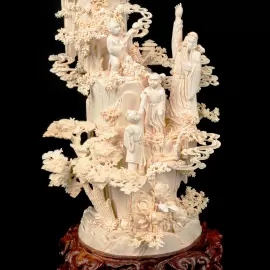
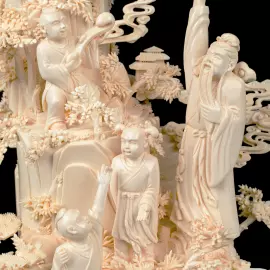
The work uses traditional bone carving techniques that expressively convey the artistic image of "Wealth and Auspiciousness," especially revered in Chinese culture. The composition combines symbolic motifs and meanings: the longevity of Sunghe, blooming abundance, signs of happiness, and the realistically executed Fulushou triad. Mighty pines, graceful cranes, magnificent peonies, blooming plums and magpies joyfully singing on the branches form a dynamic three-dimensional scene filled with a sense of harmony and prosperity. The southern mountains, revealing the greatness of nature, embody the highest benefits — wealth, well-being and longevity.
51 714 000 ₽
Available in stock
Bone composition "Favorable harmony of dragon and phoenix"
Creative idea: the work uses a mammoth tusk, as well as masterly bone carving techniques to create an expressive scene: a mighty dragon and a swift phoenix soar opposite each other, embodying the traditional image of "dragon flight and phoenix dance" — a symbol of harmonious union and supreme well-being. A luxuriantly blooming peony embodies abundance and prosperity, enhancing the overall sound of the composition. The work conveys the aspiration for a bright future filled with success and happiness. Distinguished by its thoughtful composition, expressive plasticity and subtlety of execution, the work is perceived as a rare artistic treasure.
35 802 000 ₽
Available in stock
Mammoth tusk composition "Beautiful flower and full moon" 33 spheres
The work is distinguished by the finest carvings, vividly and gracefully conveying the scene of "flowers and the full moon." In the center of the composition is the majestic Guangji Bridge over the Han River, connected to the towering Guangji Tower. Their architectural silhouette sets a solemn rhythm to the whole work. The colorful Arched Street reveals the distinctive look of the overseas Chinese hometown, in which Chinese and Western traditions are organically intertwined.
At the foot of Beacon Hill, with its back to Hanshan and facing the Han River, Hangul Gongsi is located, evoking a sense of calm grandeur. The Hanyuan and Jieyang Towers, which are part of the Kuo Daxunjian ensemble, are perceived as architectural gems connecting history and modernity. Against the backdrop of picturesque landscapes, century-old trees rise in powerful crowns, cranes soar in the sky, clouds seem to move in a dance. The human figures in the 1680 composition resemble a flock of carp, filling the scene with life and dynamics. The flowers open in full bloom, and the 33-layered sphere of bone is like a bright moon shining in the night sky.
The image of a prosperous Chinese land unfolds before the viewer — the harmony of people, nature and heavenly light, where "flowers greet wealth", and the circle of the moon symbolizes fullness and completeness. The thoughtful composition, expressive theme, rich palette of shades and elegant plastic carving are emphasized by the use of traditional techniques — round carving, relief, openwork and inlay. Thanks to this, the work acquires depth and picturesqueness, holding the gaze and gradually revealing new details.
76 659 000 ₽
Available in stock
Bone composition "Full of gold and jade"
The work vividly embodies the popular folk art motif "Jinyu Mantang" — the image of abundance and prosperity. Graceful pavilions and gazebos, mountain slopes and whimsical stones, shrouded in clouds and fog, grow out of a picturesque landscape of green mountains and waters, among birds and flowering plants. The composition is filled with a sense of harmony and natural beauty.
Immortals gather under the auspicious arch — Fuxing, Luxing and Shouxing, symbolizing happiness, prosperity and longevity. The festive and lively atmosphere reinforces the idea of a continuous influx of good luck, when "the hall is full of gold and jade," and lucky stars shine above the house.
The work is complemented by a paired composition of bone, emphasizing the traditional symbolism of unity and harmony. The image of a "couple" enhances the benevolent meaning of the work, creating a sense of completeness and inner balance. The work gives the viewer a bright, harmonious mood and a space for multi-layered associations.
The work is presented in 2 copies.
43 758 000 ₽
Available in stock
Mammoth tusk composition with Cantonese ball "Blessing of the Dragon and Phoenix" 28 spheres
The Cantonese bone ball, also known as the "ghost ball", is one of the most characteristic types of Guangzhou carvings, formed back in the Ming Dynasty. Its uniqueness lies in the fact that a single fragment of bone is hollowed out into a multi-layered sphere with intertwining openwork shells. Each layer is finely worked out with its own through-the-wall ornament and can freely rotate inside the subsequent one, creating the impression of lightness and almost weightless transparency.
The Cantonese ball is considered the pinnacle of local school craftsmanship and an important part of China's national intangible cultural heritage. Modern works often use a single mammoth tusk, which makes it possible to create complex multi-layered structures with filigree precision. The most important indicator of the master's level is the number of inner spheres: the more layers are enclosed in one ball, the higher the technical complexity and the more virtuoso the work is considered. Creating a large number of freely rotating shells requires exceptional calculation accuracy, error-free tool ownership and many years of experience.
The process of hollowing out a single multilayer sphere is extremely laborious and involves a high risk of material damage at any stage. It is this technical complexity combined with artistic ingenuity that gives the "ghost ball" its unique charm and makes each piece a testament to outstanding craftsmanship.
2 422 000 ₽
Available in stock
Mammoth tusk composition with Cantonese ball "Junshan Gao Shi" 30 spheres
The Cantonese bone ball, also known as the "ghost ball", is one of the most characteristic types of Guangzhou carvings, formed back in the Ming Dynasty. Its uniqueness lies in the fact that a single fragment of bone is hollowed out into a multi-layered sphere with intertwining openwork shells. Each layer is finely worked out with its own through-the-wall ornament and can freely rotate inside the subsequent one, creating the impression of lightness and almost weightless transparency.
The Cantonese ball is considered the pinnacle of local school craftsmanship and an important part of China's national intangible cultural heritage. Modern works often use a single mammoth tusk, which makes it possible to create complex multi-layered structures with filigree precision. The most important indicator of the master's level is the number of inner spheres: the more layers are enclosed in one ball, the higher the technical complexity and the more virtuoso the work is considered. Creating a large number of freely rotating shells requires exceptional calculation accuracy, error-free tool ownership and many years of experience.
The process of hollowing out a single multilayer sphere is extremely laborious and involves a high risk of material damage at any stage. It is this technical complexity combined with artistic ingenuity that gives the "ghost ball" its unique charm and makes each piece a testament to outstanding craftsmanship.
3 061 000 ₽
Available in stock
Mammoth tusk composition with Cantonese ball "Immortal Tong Xianshou" 32 spheres
The Cantonese bone ball, also known as the "ghost ball", is one of the most characteristic types of Guangzhou carvings, formed back in the Ming Dynasty. Its uniqueness lies in the fact that a single fragment of bone is hollowed out into a multi-layered sphere with intertwining openwork shells. Each layer is finely worked out with its own through-the-wall ornament and can freely rotate inside the subsequent one, creating the impression of lightness and almost weightless transparency.
The Cantonese ball is considered the pinnacle of local school craftsmanship and an important part of China's national intangible cultural heritage. Modern works often use a single mammoth tusk, which makes it possible to create complex multi-layered structures with filigree precision. The most important indicator of the master's level is the number of inner spheres: the more layers are enclosed in one ball, the higher the technical complexity and the more virtuoso the work is considered. Creating a large number of freely rotating shells requires exceptional calculation accuracy, error-free tool ownership and many years of experience.
The process of hollowing out a single multilayer sphere is extremely laborious and involves a high risk of material damage at any stage. It is this technical complexity combined with artistic ingenuity that gives the "ghost ball" its unique charm and makes each piece a testament to outstanding craftsmanship.
3 651 000 ₽
Available in stock
Mammoth tusk composition with Cantonese ball "Harmony. The Ercikan left column"28 spheres
The Cantonese bone ball, also known as the "ghost ball", is one of the most characteristic types of Guangzhou carvings, formed back in the Ming Dynasty. Its uniqueness lies in the fact that a single fragment of bone is hollowed out into a multi-layered sphere with intertwining openwork shells. Each layer is finely worked out with its own through-the-wall ornament and can freely rotate inside the subsequent one, creating the impression of lightness and almost weightless transparency.
The Cantonese ball is considered the pinnacle of local school craftsmanship and an important part of China's national intangible cultural heritage. Modern works often use a single mammoth tusk, which makes it possible to create complex multi-layered structures with filigree precision. The most important indicator of the master's level is the number of inner spheres: the more layers are enclosed in one ball, the higher the technical complexity and the more virtuoso the work is considered. Creating a large number of freely rotating shells requires exceptional calculation accuracy, error-free tool ownership and many years of experience.
The process of hollowing out a single multilayer sphere is extremely laborious and involves a high risk of material damage at any stage. It is this technical complexity combined with artistic ingenuity that gives the "ghost ball" its unique charm and makes each piece a testament to outstanding craftsmanship.
2 422 000 ₽
Available in stock
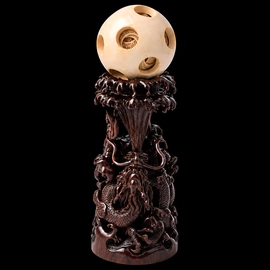
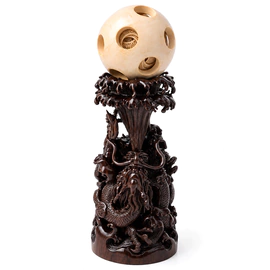
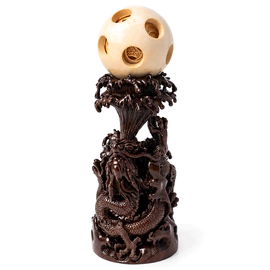
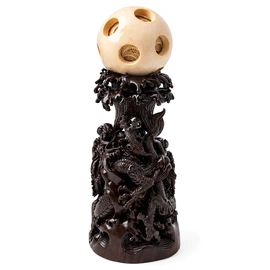
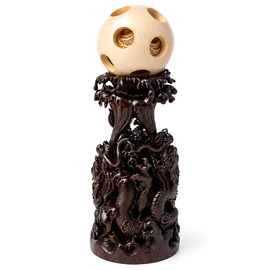
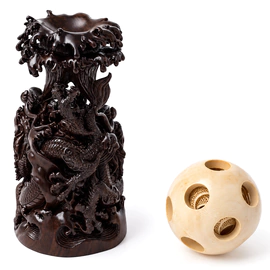
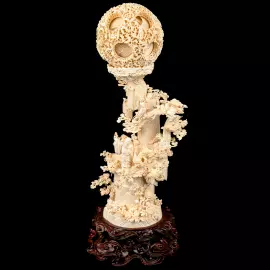
Mammoth tusk composition with Cantonese ball "Dragon" 40 spheres
The composition of a mammoth tusk with a Cantonese Dragon ball is an exquisite work of decorative and applied art, combining the ancient traditions of Chinese carving and rare natural materials. The composition is based on a mammoth tusk that has lain in permafrost for thousands of years. Its noble texture and soft cream shade emphasize the delicacy of the carving and give the work a special historical depth.
At the top of the composition is the famous Cantonese carved ball, one of the most difficult achievements of Chinese art. This multi-layered ball is cut from a single piece of material and consists of several nested spheres, each of which rotates freely inside the other. The surface of the ball is covered with the finest openwork ornaments, resembling an interweaving of clouds, flowers and waves. Such balls traditionally symbolize perfection, the infinity of the world and the harmony of the heavenly order.
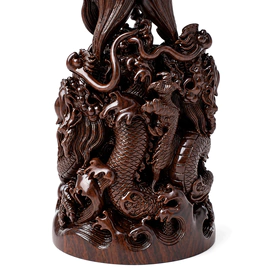
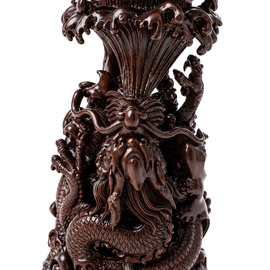
The central part of the composition is occupied by a dynamic dragon figure. In Chinese culture, the dragon is one of the most powerful and auspicious symbols, representing the power of heaven, wisdom and power over the elements. His curved body seems to move among the clouds, and the graceful lines of scales and claws create a feeling of lively movement. The dragon acts as the guardian of the celestial sphere, emphasizing the connection between cosmic harmony and the power of nature.
The light carving of mammoth bone contrasts with the dark column of the base, which gives the composition an expressive depth. This contrast enhances the plasticity of the shapes and emphasizes the skill of the artist, who managed to combine different levels of space — from a complex openwork sphere to the smooth lines of a dragon's body.
The "dragon" with a Cantonese ball symbolizes the harmony of the universe, where heavenly wisdom and natural power combine in a single movement. This work is not only a rare example of the most complex carving on a mammoth tusk, but also an artistic embodiment of the philosophical idea of a balance between heaven, earth and spirituality.
12 168 000 ₽
Available in stock