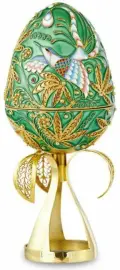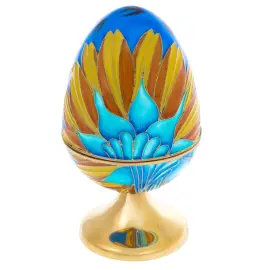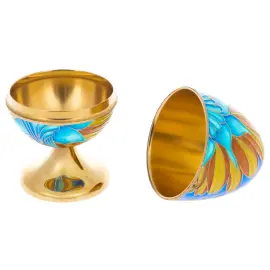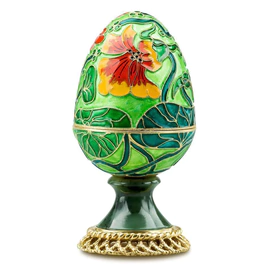
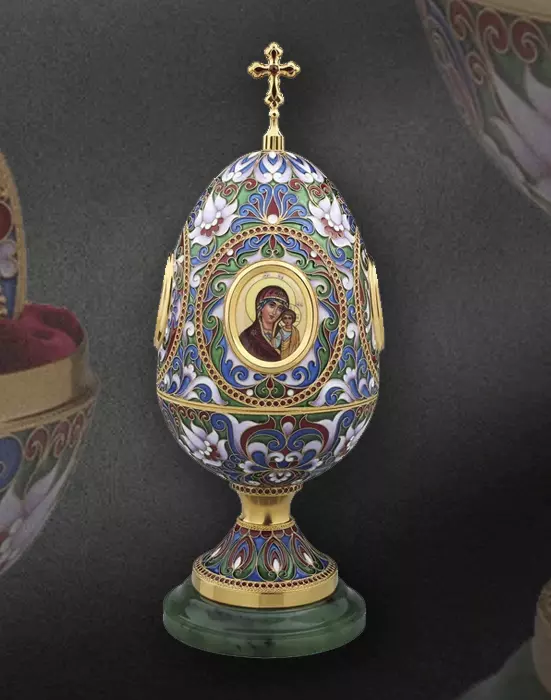













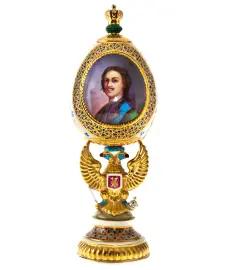
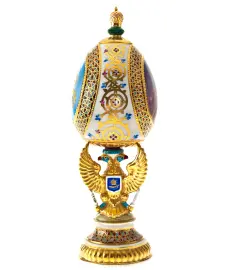
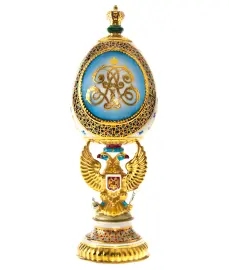
Сувенирное яйцо «Пасхальное» — утончённое произведение златоустовского искусства, в котором классическая форма соединена с ювелирной точностью исполнения. Золотистая поверхность корпуса мягко отражает свет, создавая ощущение внутреннего сияния, тогда как орнаментальный декор с серебристым оттенком формирует изящный ритм линий. Композиция дополнена вставками камней, расставляющими акценты и усиливающими декоративную глубину, а завершение в виде креста подчёркивает символический характер изделия. Предмет установлен на изящной подставке, придающей всей композиции устойчивость и завершённость, ориентирован на ценителей традиционных пасхальных образов и статусных подарков.
Работа выполнена в златоустовской технике художественной обработки металла, предполагающей сочетание литья, гравировки и золочения с последующей ручной доработкой. Орнамент выверен до мельчайших деталей, линии отличаются чёткостью и плавностью, создавая эффект тонкого кружевного узора на металле. Декоративные вставки тщательно интегрированы в композицию, усиливая игру света и придавая изделию дополнительную выразительность. Каждая деталь обработана с вниманием к пропорциям и художественной целостности формы.
Образ пасхального яйца традиционно связан с идеей возрождения, духовного обновления и торжества жизни. В сочетании с крестом композиция приобретает более глубокий символический смысл, обращённый к христианской традиции. Такое изделие воспринимается как не только декоративный объект, но и как знак уважения к культурному наследию, способный подчеркнуть вкус владельца и внести в пространство атмосферу благородной, сдержанной роскоши.
.
Expand
Characteristics
Country of manufacture:
Material:
, , ,
Technique of execution:
Sizes:
4 × 4 × 9 cm
.
Weight:
0.5 kg
.
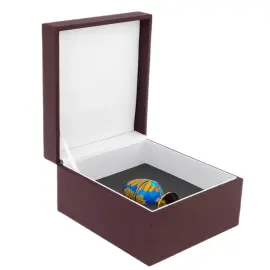
You will receive a passport with this product.
Similar products
An openwork egg with a portrait of Peter the GreatAn openwork egg with a portrait of Peter the GreatWhiter than frost and snow, more ringing than jade – the poet from the Celestial Empire, who sang porcelain, did not skimp on epithets! Among the great inventions of China, porcelain claims to be, if not the most important, then the most beautiful.
The secret of making porcelain tableware was kept in the strictest secrecy. Attempts to find her out were punishable by death. However, first exported to Asian countries, and by the XVI century to Europe, porcelain was valued above gold. Scientists and masters from all over the world struggled to reveal his secret.
The complex technology of mixing porcelain mass, which includes kaolin, quartz and mica, and no less complex roasting are just the basics learned from the Chinese. Japanese, Florentine, and Prussian porcelain manufactories added something of their own to this base, obtaining, although different from the prototype, but beautiful porcelain in its own way.
100 000 ₽
Clarify availablility
Statuette "Imperial"Statuette "Imperial"The products are made of high quality natural materials. The filigree elaboration of details characterizes the impeccable work of the master.
The product will become an exquisite status gift for a Vip person, it will perfectly fit into the rich interior of a house or office.
It is possible to manufacture according to individual sketches with the application of corporate symbols.
The production time is 15 days.
120 000 ₽
Clarify availablility
Russian GemsSilver egg-box "Hummingbird"Silver egg-box "Hummingbird"The art of creating enamel filigree products came to us from Byzantium.
The world-famous Russian jewelers K.Faberge and P.A.Ovchinnikov perfected this unique technique in the 19th century, and as a result, the phrase "Faberge Eggs" became synonymous with luxury and an emblem of the wealth of the Russian imperial house, as well as the name of the type of products in the form of eggs with surprises and one of the symbols of Russia.
The objects cast from silver are covered with the finest relief pattern of silver threads. Inside the contour is a drawing covered with glaze. Each object created in this way is unique and is a work of art.
This product is equipped with a gift box.
160 000 ₽
Clarify availablility
Russian GemsEgg-box "Flowers"Egg-box "Flowers"Despite the fact that the art of creating cloisonne enamel comes from Byzantium, it was Russian jewelers who perfected this unique technique in the 19th century. Faberge, P.A. Ovchinnikov).
Objects cast from silver are covered with the finest relief pattern of silver threads. Then an enamel pattern is applied inside the contour and the entire product is covered with glaze paint. About 20 craftsmen work on each subject. The process is very laborious, but the result is worth it, because the created object is a work of art.
190 000 ₽
Available:
Lubyanka
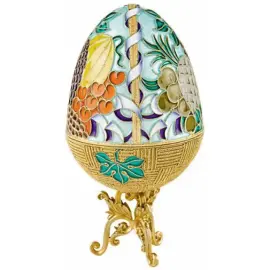
Russian GemsEgg-box "Fruits" (silver, enamel)Egg-box "Fruits" (silver, enamel)Despite the fact that the art of creating cloisonne enamel comes from Byzantium, it was Russian jewelers who perfected this unique technique in the 19th century. Faberge, P.A. Ovchinnikov).
Objects cast from silver are covered with the finest relief pattern of silver threads. Then an enamel pattern is applied inside the contour and the entire product is covered with glaze paint. About 20 craftsmen work on each subject. The process is very laborious, but the result is worth it, because the created object is a work of art.
131 600 ₽
Available:
Lubyanka
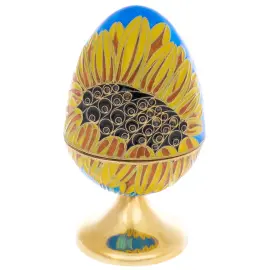
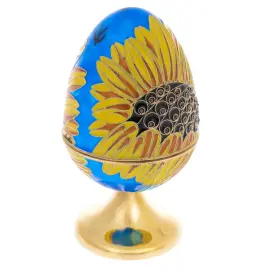
Russian GemsEgg-box "Sunflower"Egg-box "Sunflower"Despite the fact that the art of creating cloisonne enamel comes from Byzantium, it was Russian jewelers who perfected this unique technique in the 19th century. Faberge, P.A. Ovchinnikov).
Objects cast from silver are covered with the finest relief pattern of silver threads. Then an enamel pattern is applied inside the contour and the entire product is covered with glaze paint. About 20 craftsmen work on each subject. The process is very laborious, but the result is worth it, because the created object is a work of art.
120 000 ₽
Clarify availablility
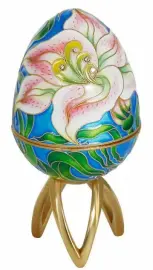
Russian GemsEgg-box "Lily"Egg-box "Lily"Despite the fact that the art of creating cloisonne enamel comes from Byzantium, it was Russian jewelers who perfected this unique technique in the 19th century. Faberge, P.A. Ovchinnikov).
Objects cast from silver are covered with the finest relief pattern of silver threads. Then an enamel pattern is applied inside the contour and the entire product is covered with glaze paint. About 20 craftsmen work on each subject. The process is very laborious, but the result is worth it, because the created object is a work of art.
150 000 ₽
Clarify availablility
Russian GemsEgg-box "Lilac" with cubic zirconia (silver, enamel)Egg-box "Lilac" with cubic zirconia (silver, enamel)Despite the fact that the art of creating cloisonne enamel comes from Byzantium, it was Russian jewelers who perfected this unique technique in the 19th century. Faberge, P.A. Ovchinnikov).
Objects cast from silver are covered with the finest relief pattern of silver threads. Then an enamel pattern is applied inside the contour and the entire product is covered with glaze paint. About 20 craftsmen work on each subject. The process is very laborious, but the result is worth it, because the created object is a work of art.