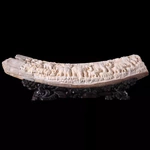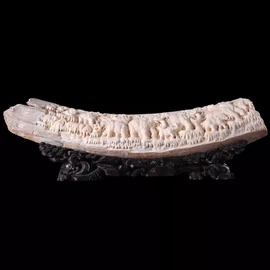











































































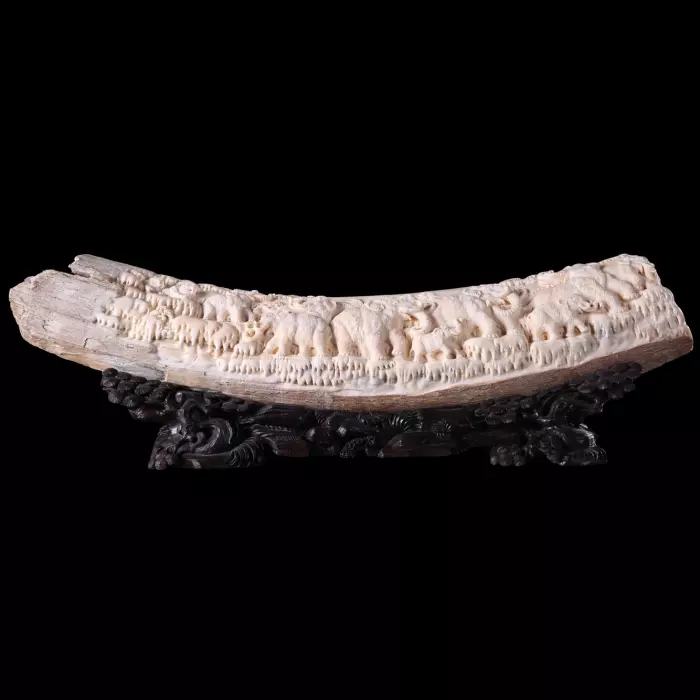

The mammoth tusk composition "The Wandering Hunter of the Icy Plain" is an expressive work in which the natural form of the material becomes the basis for a detailed narrative. The curved line of the tusk is preserved and organically incorporated into the composition, so that the work is perceived as a fragment of nature itself, transformed into an artistic image. The light texture of the bone contrasts with the dark carved base, emphasizing the depth of the relief and creating the feeling of a completed museum object.
The plot unfolds in an extended horizontal composition, where the figures of animals — primarily elephants — form a continuous progression, resembling movement across an endless icy plain. In this rhythm, one can guess the image of the ancient world, in which man and nature existed in a single space. The "wandering hunter" himself is not directly represented, but his presence is felt through the dynamics of the scene — as an invisible force accompanying and observing this path. This technique creates a narrative effect in which the viewer becomes an accomplice to what is happening.
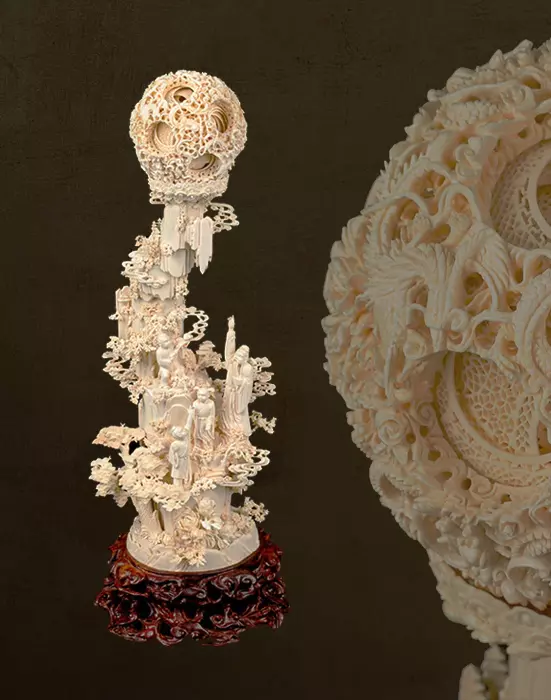
The mastery of Cantonese carving is shown in the finest detail: each figure is worked out taking into account the scale, relief and plasticity of movement. The deep slits and multi-layered structure create a sense of space and depth, despite the limited shape. The surface of the tusk is used as delicately as possible — the master preserves the natural transitions of color and texture, turning them into part of the artistic idea.
The "Wandering Hunter of the Icy Plain" is not just a decorative object, but an image of the path, time and human interaction with the primordial world. The composition carries a sense of ancient strength, tranquility and continuous movement, becoming a symbol of endurance, observation and inner connection with nature.