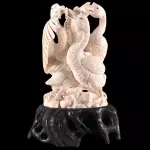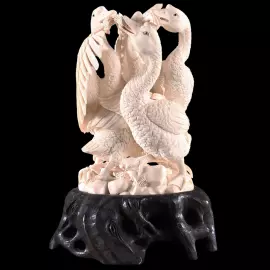


























































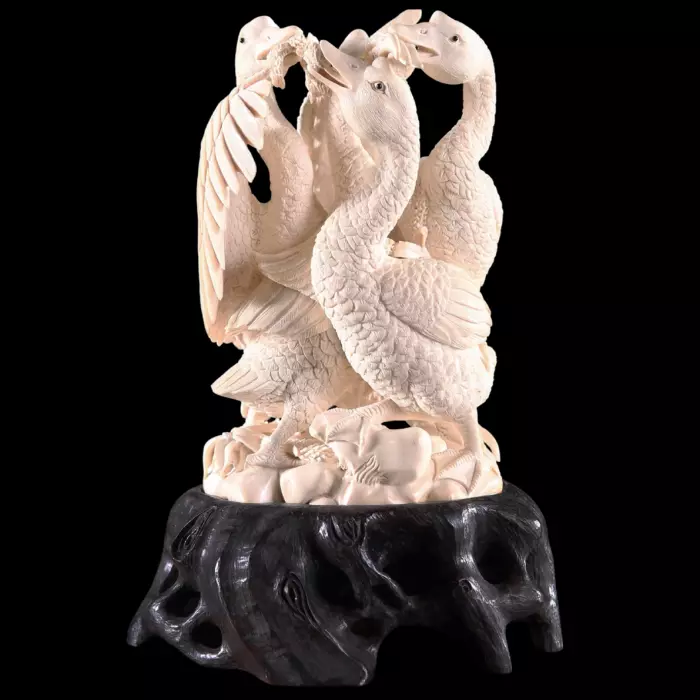
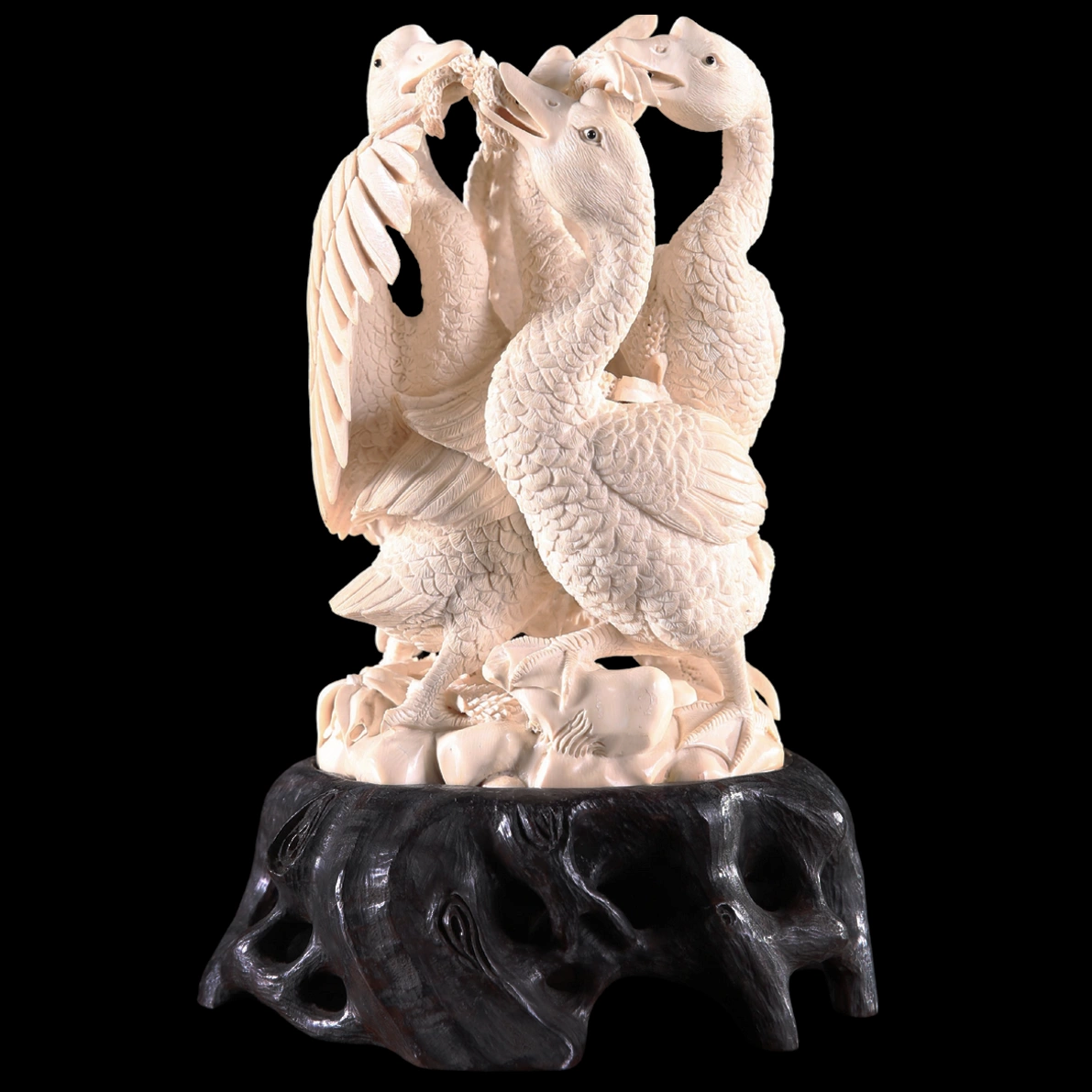
The mammoth tusk composition "Flock of Swans" reveals the image of harmony, fidelity and unity, qualities deeply rooted in Chinese symbolism. Swans in Eastern culture are perceived as the embodiment of purity, nobility and sincere affection, and their joint movement reinforces the importance of mutual support and consent.
The image of several birds intertwining their necks and forming a closed rhythm symbolizes an indissoluble bond. In the Chinese tradition, such compositions are interpreted as a wish for family well-being, strong relationships and a long union. Swans who remain faithful to their partner become a natural way of harmonious relationships based on trust and consistency.
The smooth lines of the bodies and the soft dynamics of the composition create a sense of movement in which there is no sharpness — only fluidity and consistency. This reflects an important principle for Chinese philosophy: true harmony is achieved not through effort, but through natural harmony, when each part exists in rhythm with the others.
The very theme of the "pack" gives additional meaning. Unlike a single image, the idea of a community arises here, where each figure enhances the other. It is a symbol not only of love, but also of support, stability and unity in a broader sense — be it family, clan or environment.
"A flock of swans" is an image of purity of feelings, loyalty and harmonious unity. The composition combines the rarity of a mammoth tusk, the most subtle elaboration of form and deep symbolism, creating a work filled with soft power, calmness and a sense of stable, favorable union.