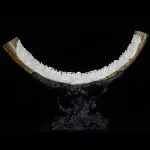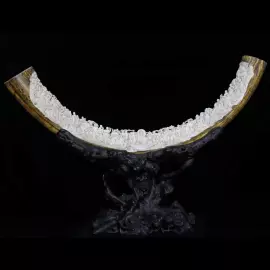


















































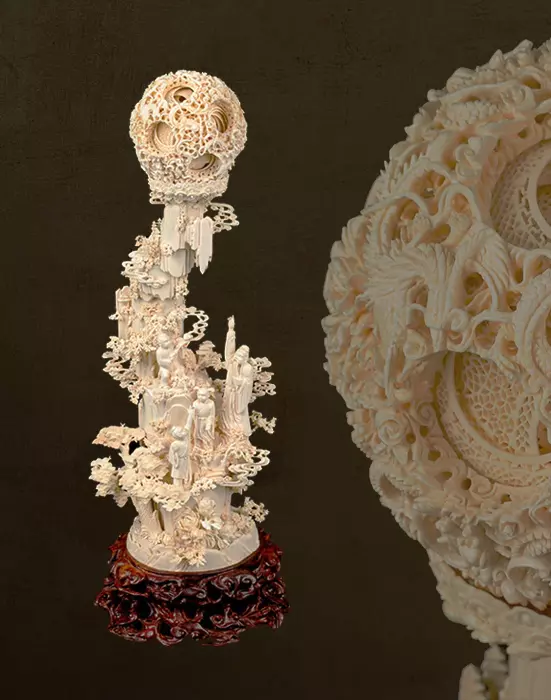





















The mammoth tusk composition "Dharma Presentation Image" addresses one of the central themes of the Buddhist tradition — the transmission of teachings, the revelation of truth and the path to liberation. The name itself refers to the moment of preaching the Dharma, the sacred knowledge that the Buddha imparts to His disciples, revealing to them the nature of suffering, its causes, and the path to enlightenment. In Chinese culture, such scenes are perceived not as a historical episode, but as an eternal act — knowledge that is continuously transmitted from teacher to student.
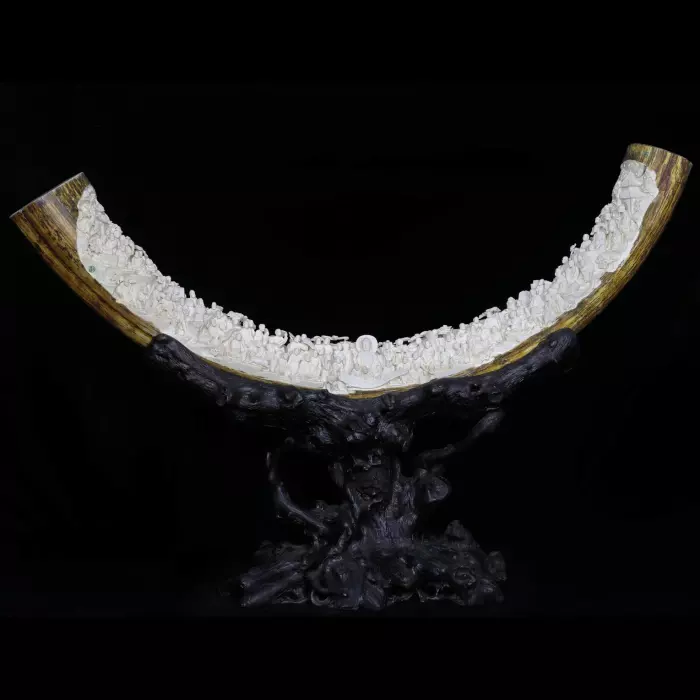
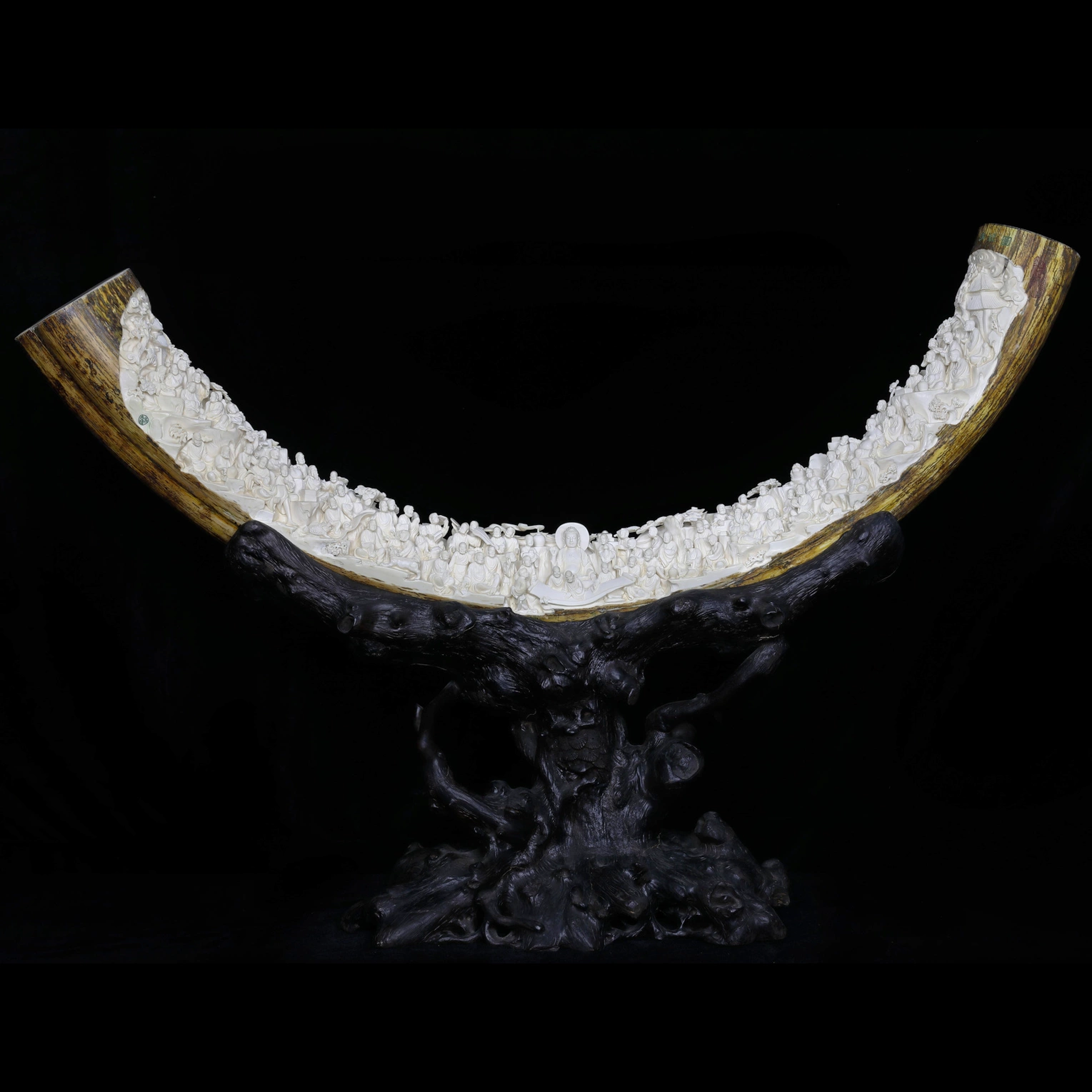
The composition features a large-scale gathering scene: in the center is the figure of the Buddha, immersed in a state of inner concentration and peace. Around him are numerous disciples, bodhisattvas, and listeners, each of whom is presented in a unique pose expressing attention, reverence, or meditation. This construction reflects the idea of a spiritual hierarchy and at the same time unity — all figures are united by the desire to understand the truth.
The multitude of characters symbolizes the breadth of the teaching: the Dharma is addressed to all beings, regardless of their level of development. In the Chinese tradition, such scenes are often interpreted as an image of an ideal world order, where knowledge occupies a central place and wisdom becomes the basis of harmony.
The plasticity of the composition is built as a continuous flow: the figures follow one another, forming a rhythm resembling an unfolding scroll. This creates the effect of movement — not physical, but spiritual, where each step brings us closer to understanding the truth. The viewer's gaze moves along the tusk, gradually sinking into the depth of the plot.
The semantic meaning of the work goes beyond the religious context. In Chinese culture, the "Dharma exposition" symbolizes not only the teachings of the Buddha, but also the very process of knowledge transfer, the continuity of tradition, respect for a mentor, and the value of inner development. It is an image of a dialogue between a teacher and a student, between the past and the present, between form and meaning.
The "Dharma Presentation Image" is a visual representation of the idea of enlightenment through understanding. The composition combines the rarity of the material, the highest craftsmanship of carving and a deep philosophical foundation, creating a work of contemplation, reflection and inner search.