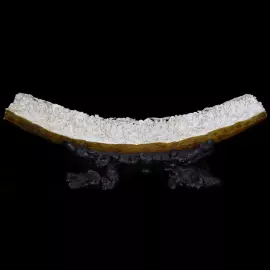





































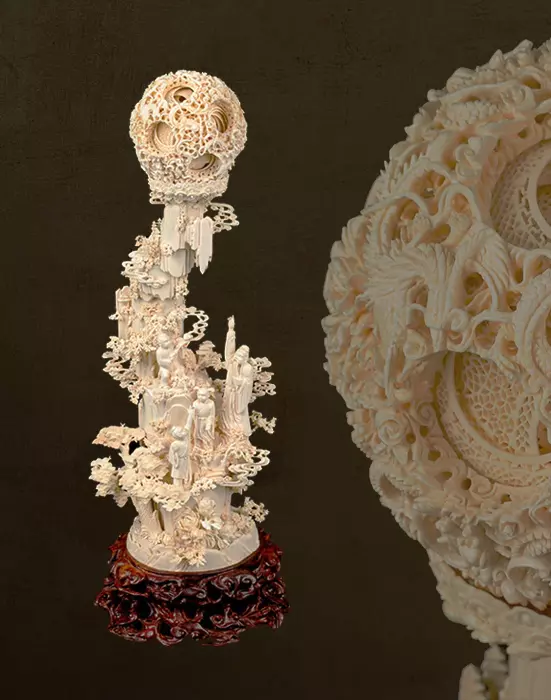


















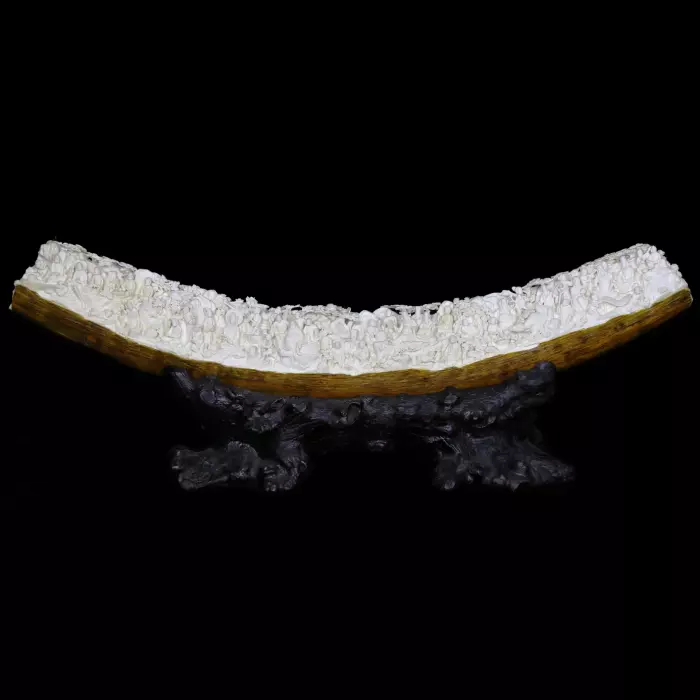
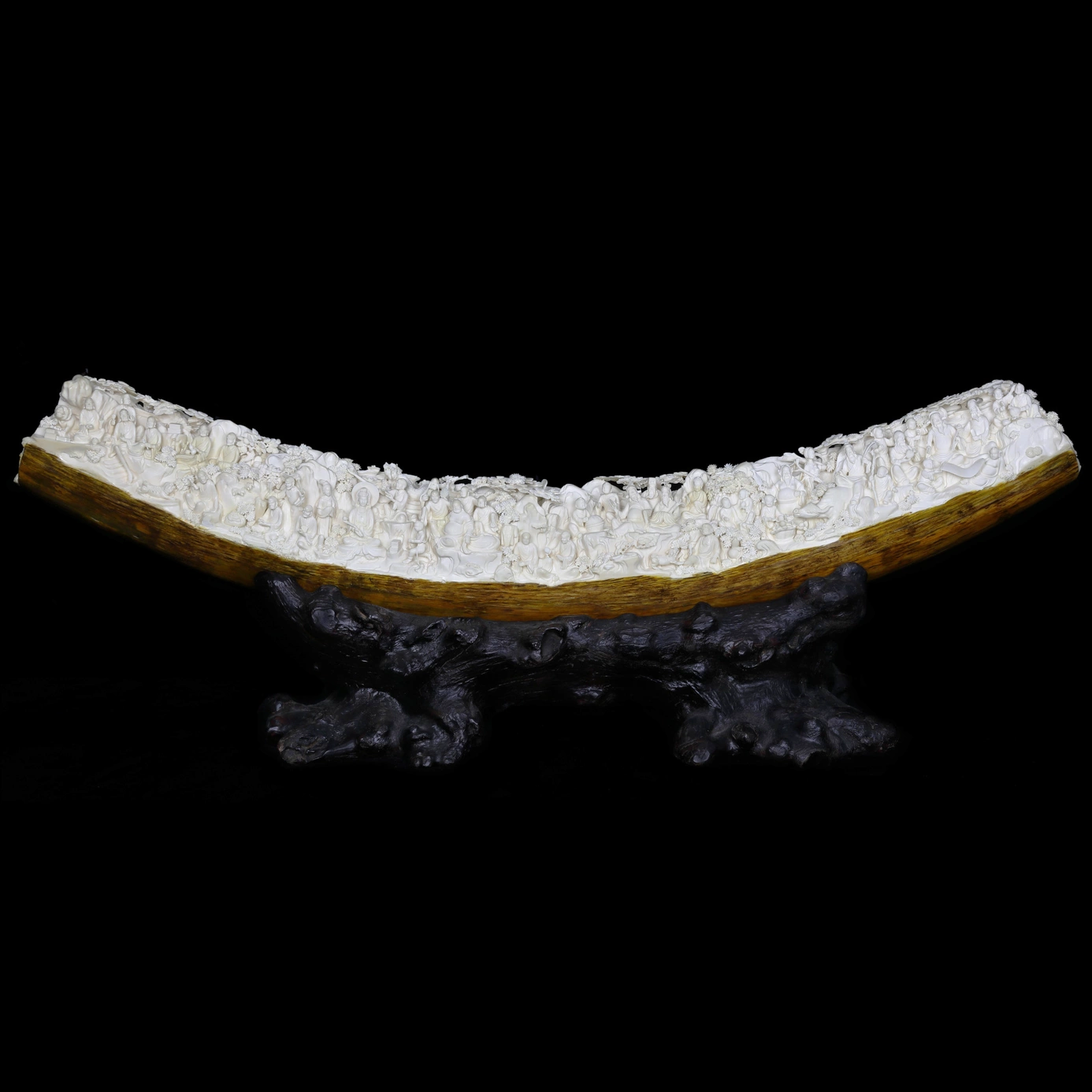
The mammoth tusk composition "The Unity of the Source: Buddhism and Taoism" reveals one of the deepest ideas of Chinese philosophy — the idea that different spiritual paths, despite external differences, lead back to a single truth. The name itself refers to the concept of "three teachings — one beginning", where Buddhism, Taoism and Confucianism are perceived not as opposed systems, but as complementary forms of understanding the world.
The composition contains a complex scene that unites many figures, among which one can distinguish images of Buddhist and Taoist characters — sages, saints, immortals, and disciples. They coexist in a single space without conflict, forming a harmonious community where each tradition retains its individuality, but at the same time is included in the general order. Such an association symbolizes the idea of harmony and interpenetration of teachings.
Buddhism in Chinese culture is associated with the search for liberation from suffering, understanding the nature of the mind and achieving enlightenment. Taoism, in turn, is directed towards naturalness, following the Tao path that underlies everything, and harmony with nature. In this composition, these two directions are not opposed: they are presented as different ways of moving towards the same goal — inner balance and comprehension of truth.
The multifiguration of the scene enhances the sense of wholeness: each character is part of a single stream, where there is no division into "right" and "wrong", but there are different levels of understanding. This construction reflects traditional Chinese thinking, which tends towards synthesis rather than strict differentiation.
The narrative develops smoothly, without sharp boundaries between scenes, creating the effect of continuous movement — as if the viewer is watching an unfolding philosophical treatise embodied in the form of carvings. This technique emphasizes the idea of a single source from which different forms of knowledge flow.
"The Unity of the Source: Buddhism and Taoism" is not just a decorative composition, but an image of philosophical agreement, where differences become part of harmony. The work combines the rarity of the mammoth tusk, the highest craftsmanship of carving and deep symbolism, expressing the idea of unity underlying the diversity of spiritual paths.