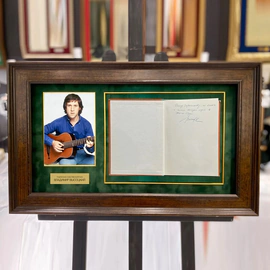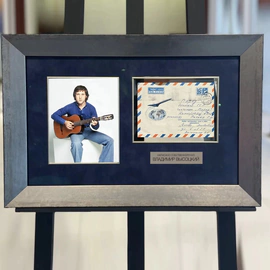








































Автограф Владимира Высоцкого
(8)
История, сохранившаяся в подлинных вещах и автографах знаменитостей - лучший подарок для коллекционера.
Filters
Available first
Автографы и вещи знаменитостей
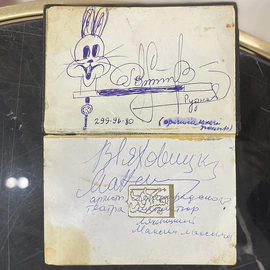
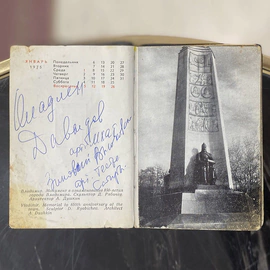
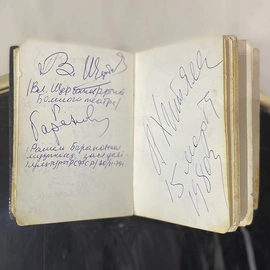
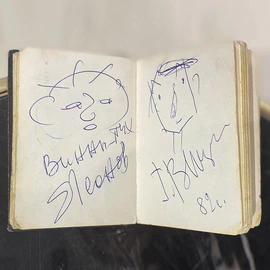
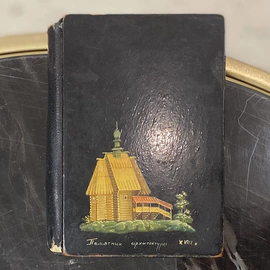
A notebook with autographs of cultural figures Vladimir Vysotsky, Vyacheslav Tikhonov, Leonid Bronevoy, Georgy Zhzhenov, Alexander Pankratov-Cherny, and others
A notebook with autographs of cultural figures
Vladimir Vysotsky is a Soviet poet, theater and film actor, and bard. A phenomenal phenomenon in Russian culture. Through his work, Vysotsky formed moral guidelines, views, thoughts, and the civic position of his fans. The artist's literary legacy includes more than 200 poems and approximately 600 songs.
Vyacheslav Tikhonov is a Soviet and Russian film and voice actor who played in such films as "Seventeen Moments of Spring", "It was in Penkov", "The Young Guard".
Leonid Bronevoy is a Soviet and Russian theater and film actor who played roles in the films "Seventeen Moments of Spring", "Comrade Arseny", "The investigation is conducted by experts".
Georgy Zhzhenov is a Soviet and Russian theater and film actor, writer, memoirist, and public figure. He starred in the films "Chapaev", "Beware of the car", "Resident's Mistake".
Alexander Pankratov-Cherny is a Russian actor and director, remembered for his roles in the films "The Forgotten Melody for the Flute", "Cruel Romance" and "Promised Heaven".
Yulia Borisova is a Soviet and Russian actress. She is known for her roles in the films "Idiot", "Irkutsk Story", "Ambassador of the Soviet Union".
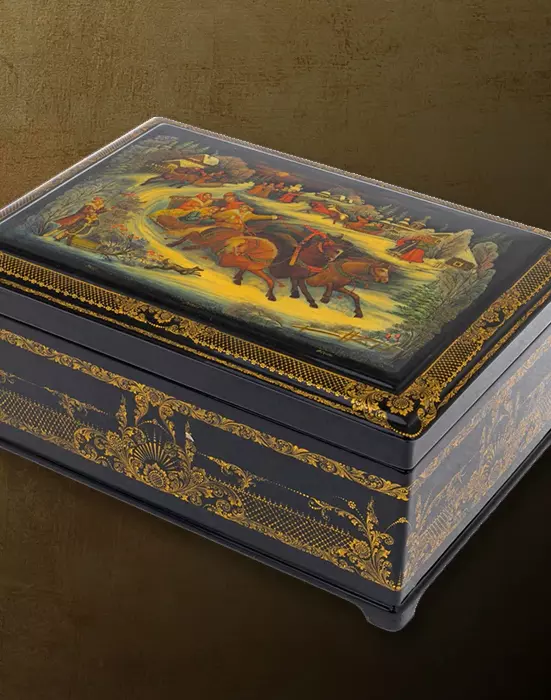
The Stargift collection features a unique exhibit — a notebook stylized as a Palekh miniature, which contains more than 100 autographs and signatures of cultural figures. Including the signatures of Vysotsky, Tikhonov, Bronevoy, Petrosyan, Pankratov-Cherny, Borisova, Yursky ("In memory of a wonderful meeting"), Nikolaev ("Happy New Year "Morning Mail"), Zhzhenov ("Lucy with pleasure") and many others.
Based on the recording of the actor of the Lenkom Vsevolod Larionov ("It's a pity that the hostess is being watched"), it can be assumed that the recipient of the autographs was a technical employee of one of the houses of creativity, who collected signatures in 1975- 1980.
The exhibit, presented in the Stargift collection and signed by iconic actors of his time, can be called a monument to the turning years in the history of the development of Soviet cinema. The 1970s were the "Golden" decade, which presented the audience with a huge number of the most popular paintings. Since the ideological component was weakened, and everything innovative and highly social was denied, the directors turned to the lives of ordinary Soviet citizens with their families. People who were far from any feats now became heroes.
In the 1980s, a large number of films were shot, recognized as classics of Soviet cinema: "Boris Godunov", "Moscow does not believe in tears", "Train station for two", "Cruel Romance". Vladimir Menshov's melodrama won the Oscar for Best Foreign Language Film in 1981 and was released worldwide. At European film festivals, Soviet cinema collected a scattering of prizes every year. I will have the honor to inform Your Excellency about the final order regarding the appointment of Vasily Debu to the said school in due course.
With great respect, I stay
Yours [not razb.]
Alexander."
1 500 000 ₽
Available in stock
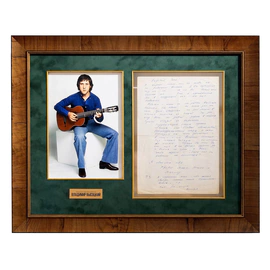
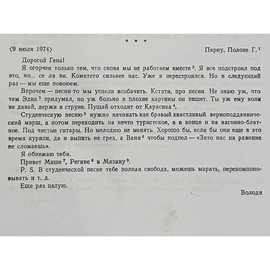
A handwritten letter from Vladimir Vysotsky addressed to film director Gennady Poloka, Moscow, July 9, 1974.
The text of the letter:
"Dear Gena, I'm just sad that we're not working together again. I've set everything up for this, but... se la vie. The Committee is stronger than us (...) However, we managed to get the songs. (...). The student song ["Whoever is a quarter of a century older than us is..“] you need to start as a brave, boastful, loyal march, and then switch to something tourist-like, and finally to a car-thug. To clean guitars. But don't change the melody. It would be nice if they were still smoking at that time, and it's not a sin to drink, but Vanya [the main character of the picture, played by A. Papanov], to sing along: "But you can't break us on the plain." I'm hugging you. Greetings to Misha, Regina and Mazin.
P.S. In a student song, you have complete freedom, you can dirty, rearrange, etc. I kiss you again. Volodya."
Vladimir Vysotsky is a poet and artist, a phenomenal phenomenon in Russian culture, which has no equal. Vysotsky's creative legacy is not measured by the number of poems and songs he wrote or the vividness of the roles he played, and is something more than books and films, because it is part of the genetic code of every Russian.
Gennady Poloka is a Soviet and Russian film director, screenwriter and actor. With an excellent directorial eye, Gennady Ivanovich immediately saw Vysotsky's acting talent: "He was a fantastic artist! Apart from his temperament, he had the ability to completely transform beyond recognition..."
All the songs for the film were written by Vladimir Vysotsky, however, of the eight songs, only five were included in the film, almost all in stripped-down versions. The only song included in the film in its entirety is "Whoever is a quarter of a century older than us is...".
Initially, in the movie "Once Alone", which was shot in the Estonian city of Pärnu, Vysotsky was supposed to play one of the roles, but was not approved by the leadership of the USSR State Committee and the role was played by N. Karachentsov. The Misha, Regina and Mazin mentioned in the letter are the artist Mikhail Savelyevich Shcheglov, who worked with Vysotsky in the films "Intervention", "One of Us", "Once Alone"; the actress Regina Leonidovna Korokhova, at that time the wife of G. Poloka, and the director of the film "Once Alone" Alexander Grigorievich Mazin, who also worked in the group of the movie "Intervention".
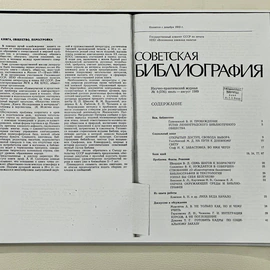
A copy of the Soviet Bibliography magazine No. 4 (236) July-August 1989 is attached to the lot, in which the submitted letter was published on pp. 83-84, as well as a magazine with a published interview by Gennady Poloka.
4 000 000 ₽
Available in stock
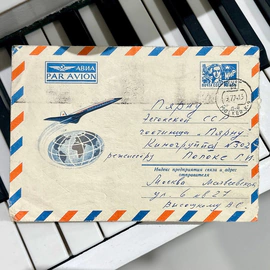
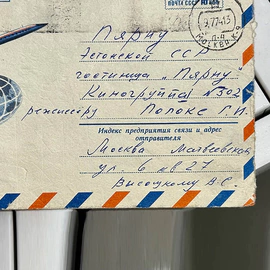
An envelope with a handwritten text by Vladimir Vysotsky
Vladimir Vysotsky is a figure who has crossed the boundaries of genres, eras, and even the state system. His voice was something that could not be silenced: raucous, piercing, resonating in the soul of everyone who heard his songs. He didn't just sing — he lived in his lyrics, burned through every line, made every word throbbing, alive. They believed him because he didn't play — he existed in every role, in every poem, in every chord of his seven-string guitar.
This envelope is a rare witness to a personal story. Addressed to Gennady Poloka, a director with a keen eye for talent, it captured a moment in which Vysotsky aspired to be not only the voice, but also the face of cinema. The film "Alone Alone" could have been another milestone in his acting career, but the system did not allow him to appear on the screen. The USSR State Cinema preferred to do without his participation, however, even cut off from the main role, Vysotsky remained in this film through music. His songs, albeit in a truncated form, became part of the picture, penetrating it with the nerve of his work.
The director was not mistaken about Vysotsky, he saw in him something that could not escape the real master. Vysotsky wasn't playing, he was reincarnating. His talent went beyond the stage stage, he penetrated into the innermost depths of the images he created. Gennady Poloka spoke of him simply: "He was a fantastic artist." These words are a recognition of a man who understood real art, of people who are able to change the space around them with just their presence.
The envelope containing these invisible threads of connection between Vysotsky and the director is more than a postal relic. It carries the breath of time, the atmosphere behind the scenes, the invisible chronicle of Soviet art, where creativity faced prohibitions, but still made its way through any obstacles. It contains a piece of the great poet, actor, musician, whose voice has forever remained in history.
This artifact is not just a collector's item, but a door to a world where Vysotsky is still alive. Where his lines still burn with truth, where his songs sound in the semi-darkness of Moscow kitchens, where his talent continues to inspire. This is a thing for those who understand that real art is timeless.
1 200 000 ₽
Available in stock
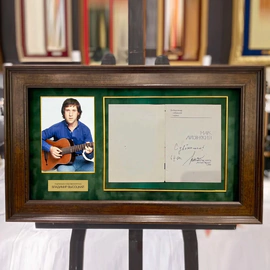
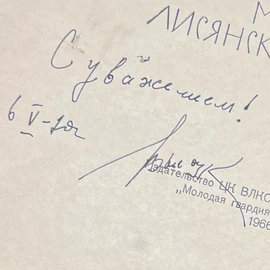
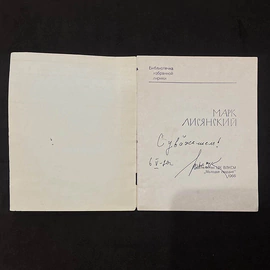
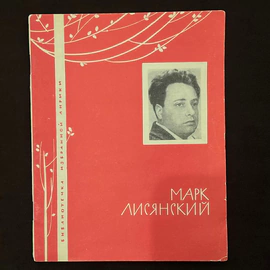
The book "Mark Lisyansky" with a handwritten wish and autograph by Vladimir Vysotsky
Vladimir Vysotsky and Mark Lisyansky are two pillars of Soviet poetry, two figures whose voices resounded in different eras, but with the same power. Vysotsky is the muffled timbre of guitar strings, tearing through prohibitions, full of meaning and unresolved questions. Lisyansky is a classical poetic tradition, the voice of the country, praising the era, its hopes and greatness. Their work moved in parallel, but one day they crossed paths, leaving a mark in history — and in this rare artifact.
This book is not just a collection of Lisyansky's lyrics, but a living memory of the meeting of two poets, two generations, and two forms of artistic expression. Inside is a handwritten wish in Vysotsky's handwriting: "Respectfully! 05/06/70". The rigor and conciseness characteristic of his style seem to convey a restrained appreciation to a man whose poems he knew and respected. This is not just an autograph, but a sign of belonging to the great tradition of Russian poetry, to its continuous flow, in which Vysotsky saw his mission.
Lisyansky was not only the author of exquisite lyrics, but also the man who wrote the lines that became the anthem of Moscow. His songs were performed by the voices that defined the sound of the era: Magomayev, Kobzon, Leshchenko, Zykina. Vysotsky, with his underground, protesting sound, seemed to be on the other side of the barricades, but poetry does not tolerate borders. They were united by the main thing — a word capable of turning souls.
Their creative paths crossed in the theater. Vysotsky, whose acting talent revealed his talent in many ways, played a central role in the play "Diary of a Woman", which featured songs based on Lisyansky's poems. It became a rare example of the collaboration of two masters, two views on art, converging in one production, in one room, at the same time.
This copy is more than just a book. It is a document of an epoch, an artifact bearing the spirit of the time, in which the word was a weapon, the song was a manifesto, and poetry was eternity. By owning it, you get not just a material object, but the opportunity to hold in your hands the particles of two great destinies, imprinted in a short but meaningful inscription.
1 200 000 ₽
Available in stock
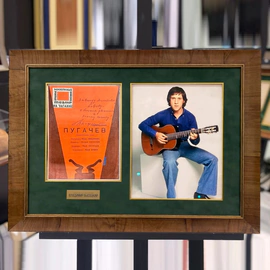
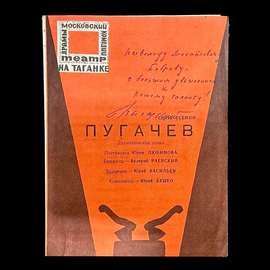
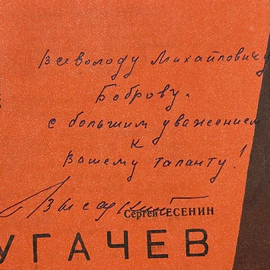
The program of the play "Pugachev" with an autograph by Vladimir Vysotsky and a handwritten wish to Vsevolod Bobrov (1960s-70s)
Request text:
"To Vsevolod Mikhailovich
Bobrov
With great respect
to
Your talent!
Vysotsky"
Vladimir Vysotsky is a Soviet actor, poet, singer and songwriter, one of the most prominent and significant figures in Russian culture of the 20th century. He is known for his soulful songs reflecting the lives and experiences of ordinary people, and roles in theater and cinema, including work at the Taganka Theater. Vysotsky became the voice of his generation, leaving a legacy that continues to inspire millions.
Vsevolod Bobrov is a legendary Soviet athlete and coach, Master of Sports of the USSR, known for his achievements in football and hockey. He was a man of exceptional talent and charisma, which made him an idol for millions. The dedication on the program of the play emphasizes Vysotsky's respect for the outstanding personalities of his time.
The play "Pugachev" was staged at the Taganka Theater under the direction of Yuri Lyubimov. It was a bold and profound interpretation of Sergei Yesenin's dramatic poem, combining the power of the literary word and unique directorial techniques. Vysotsky played the role of Flapper in it, which he performed with inimitable energy, becoming one of the central figures of the production. The music by Yuri Butsko and the design by Yuri Vasiliev enhanced the emotional impact of the play, making it one of the most notable works in the theater's repertoire.
1 500 000 ₽
Available in stock
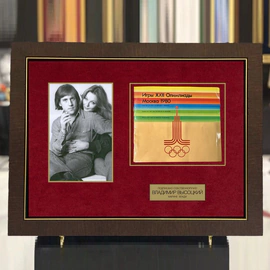
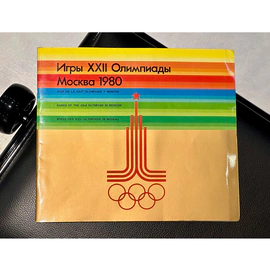
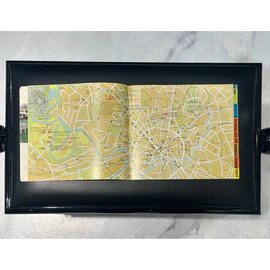
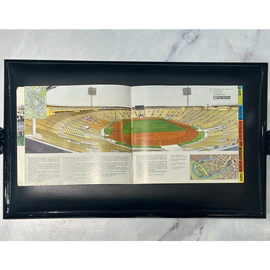
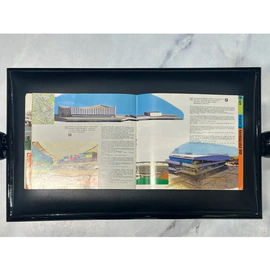
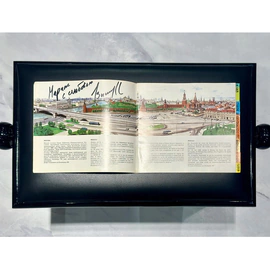
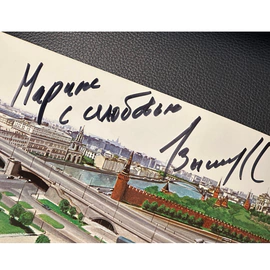
Brochure "Games of the XXll Olympiad. Moscow 1980" with a handwritten address and autograph by Vladimir Vysotsky
The text of the appeal:
"Marina
with love
Vysotsky"
Vladimir Vysotsky is a legendary Soviet poet, singer, performer, theater and film actor. Vysotsky became a cult figure of Soviet culture, his songs resonated with millions of people. He was known for his expressive manner of performance and profound lyrics that dealt with acute social issues, human experiences and life paradoxes.
The games of the XXII Olympiad, held in Moscow in 1980, became one of the significant events in the history of sports and the Soviet Union. Despite the political boycott by some countries, the Olympics brought together athletes from 80 countries and became a symbol of sporting achievements and international cooperation. The Games left a significant mark on the cultural and sports life of the country, and were also marked by large-scale opening and closing ceremonies, memorable records and outstanding performances.
1 800 000 ₽
Available in stock
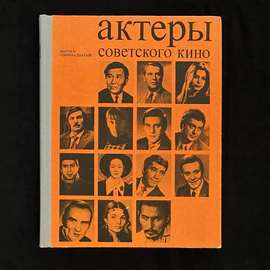
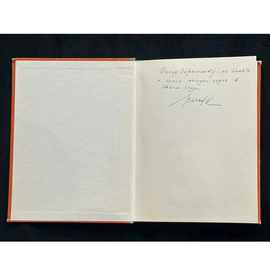
The book "Actors of Soviet cinema" with a handwritten address and autograph by Vladimir Vysotsky
The text of the appeal:
"Oleg Gerasimov - in memory
about our young years in
the studio school
Vysotsky"
Vladimir Vysotsky is a Soviet poet, theater and film actor, and bard. A phenomenal phenomenon in Russian culture. Through his work, Vysotsky shaped the moral guidelines, views, thoughts, and civic position of his fans. The artist's literary legacy includes more than 200 poems and approximately 600 songs.
Oleg Gerasimov is a famous actor and director, a teacher at the Moscow Art Theater Studio School. He was one of Vysotsky's mentors at the beginning of his career. Their collaboration continued after graduation — in 1976, they jointly created an audio staging of Alice in Wonderland, where Gerasimov directed the production, and Vysotsky wrote songs and poems for this project.
The book "Actors of Soviet Cinema" is an annual collection dedicated to outstanding artists of Soviet cinema. This 11th issue, published in 1975, includes creative portraits of such actors as Shaken Aimanov, Mark Bernes, Natalia Bondarchuk, Evgenia Vasilyeva, Vladimir Vysotsky, Vakhtang Kikabidze, Spartak Mishulin, Yuri Solomin, Anatoly Solonitsyn, Suimenkul Chokmorov and others. The authors of the collection analyze the iconic roles of these actors, revealing the unique features of their work. The book is richly illustrated with portraits of artists and film stills and is intended for a wide audience of film lovers.
1 500 000 ₽
Available in stock
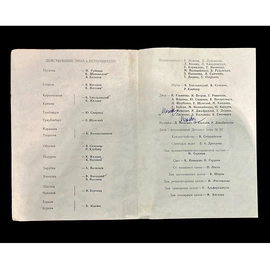
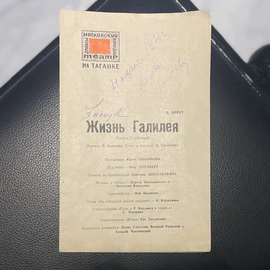
Brochure for the play "The Life of Galileo" with an autograph by poet and singer Vladimir Vysotsky
Vladimir Vysotsky is a legendary Soviet poet, singer, performer, theater and film actor. Vysotsky became a cult figure of Soviet culture, his songs resonated with millions of people. He was known for his expressive manner of performance and profound lyrics that dealt with acute social issues, human experiences and life paradoxes.
The Life of Galileo is a play by German playwright Bertolt Brecht, dedicated to the fate of the great Italian scientist Galileo Galilei, who faced resistance from the church and society because of his scientific discoveries. In the work, Brecht explores the theme of the conflict between science and power, the responsibility of a scientist to humanity, and the price of compromise. The play has been repeatedly staged on stages around the world and has become one of the author's most significant works.
In Soviet theatrical history, a special place is occupied by the production of "The Life of Galileo" at the Taganka Theater, where the role of Galileo was played by Vladimir Vysotsky. This image became one of his most profound dramatic works, in which he invested not only his acting skills, but also his inner protest against dogmas and limitations.
1 500 000 ₽
Available in stock